



Two treatments. One goal. Very different ways of getting there.
If you have been going back and forth on whether a collagen tan can or a spray tan makes more sense for you, welcome. This is the breakdown you have been looking for, without the sales pitch and without the version that avoids saying anything useful.
Cape Town has no shortage of options, from studios along the Atlantic Seaboard to wellness clinics in Sea Point, Claremont, and everywhere in between. The question is not where to go. It is what you are actually choosing between.
What Each Treatment Actually Is
A spray tan is entirely topical. No UV involved. A fine mist of dihydroxyacetone (DHA), a sugar-derived compound, is applied to your skin surface. DHA reacts with amino acids in your outermost skin layer to produce a brown colour. Nothing enters the skin. Nothing changes inside it. You are staining the outside of it and it looks convincing when done well.
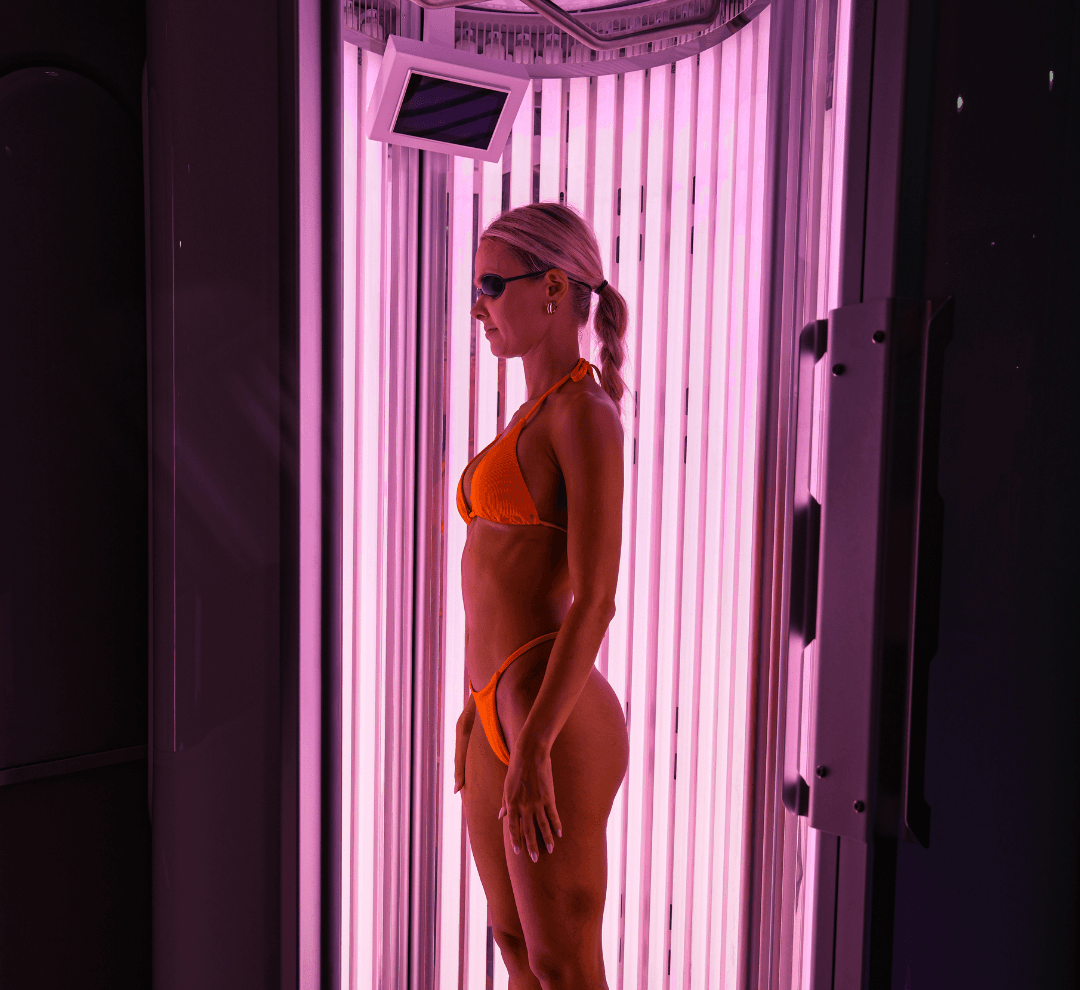
A collagen tan can is a different category of treatment entirely. It combines low-intensity UV light with collagen-stimulating light technology, specifically red light wavelengths that penetrate into the deeper layers of your skin. The UV triggers your body's own melanin production. The red light stimulates fibroblast activity, which is the cellular process responsible for producing collagen and elastin. For the full explanation, see what a collagen tan can actually is.
One colours the skin. The other changes what is happening inside it.
The Numbers Worth Knowing
Before getting into the comparison, a few figures that put the conversation in context.
1% | The rate at which collagen production declines per year from your mid-twenties onwards. By 40, most people have lost a measurable amount of skin density. |
630nm to 850nm | The red and near-infrared wavelength range shown in peer-reviewed dermatology research to stimulate fibroblast activity and collagen synthesis in skin tissue. |
5 to 10 days | The average lifespan of a spray tan before it starts to fade, highly dependent on skin hydration, exfoliation prep, and how often you are in the water. |
7 to 14 days | The average lifespan of a collagen tan can tan, which fades more gradually because the colour is produced from within the skin rather than applied to its surface. |
75%+ | The increase in melanoma risk associated with indoor tanning before age 35, according to the Skin Cancer Foundation (while the World Health Organisation cites a 59% increase). It is crucial to note that both of these figures refer to the use of traditional high-intensity UV beds, not low-output collagen systems. |
What is the difference between a collagen tan can and a spray tan?
Colour and appearance
Spray tans can be dialled to your exact preference. Fair, medium, deep, immediately visible. In the right hands, with proper skin prep, a spray tan looks genuinely good. The risk is in the execution. A bad formulation, patchy application, or insufficient exfoliation produces the orange undertone that has become universally recognisable as a spray tan that went wrong. That is a prep and formulation issue, not an inherent flaw in the treatment.
A collagen tan can gives you a gradual build over sessions. It looks natural because it is natural, your body's actual melanin response. The colour tends to develop more evenly and fade more gracefully. The trade-off is that you cannot walk out looking tanned on day one.
How long it lasts
Spray tans typically last five to ten days. They fade from the outside inward, meaning toward the end of the cycle they can look patchy if your skin is dry or if you have been spending long days at Clifton or in the gym.
A collagen tan can tan lasts seven to fourteen days on average. Because it is embedded in the skin rather than sitting on top of it, it fades more gradually and more evenly. Regular sessions maintain a base that does not need constant topping up.
What it does for your skin beyond the colour
This is the biggest difference and it is worth taking seriously.
A spray tan is a purely aesthetic treatment. The FDA considers DHA safe for external application to the skin surface, though their guidelines specifically advise protecting the eyes, lips, and mucous membranes, and avoiding inhalation during the spray process. As long as those precautions are met, it does not damage the skin. But it also does not contribute anything to it. The result is colour, nothing more.
A collagen tan can actively stimulates collagen synthesis during every session via the red light component. Over time and with consistent use, this contributes to improved skin texture, firmness, and elasticity. Research published in journals including Photomedicine and Laser Surgery and the Journal of Cosmetic and Laser Therapy consistently supports red light therapy as a meaningful contributor to skin health at a cellular level. While these clinical studies focus on targeted red and near-infrared light therapy rather than this specific tanning brand, the 630nm to 850nm wavelength technology utilised inside the tan can is built on this exact proven mechanism.
Convenience
Spray tan wins this without debate. You book, you arrive, you leave looking like you have been somewhere warm. Done in under half an hour. For an event, a holiday, or a Saturday night in Camps Bay, spray tan is the pragmatic answer.
Collagen tanning is a commitment to a routine. Results compound over sessions. If you need colour by Friday, this is not your Friday solution.
The experience
A spray tan session is functional. Technician applies product, you dry, you leave. It does what it is supposed to do efficiently and without much more to say about it.
A collagen tan can session is a different kind of experience. The environment is warm, the red light has a genuinely calming quality, and most people come out feeling noticeably better than when they went in, not just in terms of colour but physically. The mood benefit is real. For anyone managing stress, training hard, or wanting to stack their wellness routines by pairing a session with IV therapy, the physical and mood benefits are a meaningful distinction.
Collagen Tanning vs Spray Tan: Side-by-Side Comparison
Collagen Tan Can | Spray Tan | |
How it works | Low UV + collagen light technology | DHA chemical reaction on skin surface |
UV exposure | Low intensity UV | None |
Results timeline | Gradual, builds across sessions | Immediate |
Tan duration | 7 to 14 days, maintains with sessions | 5 to 10 days, fades from outside in |
Skin health benefit | Active collagen stimulation | Aesthetic only |
Best for | Long-term glow, skin investment | Events, convenience, UV sensitivity |
Experience | Restorative and calming | Functional and efficient |
How much does a collagen tan can cost vs a spray tan in Cape Town?
When determining which option is actually "worth it," the decision comes down to price, time, and maintenance. In Cape Town, a premium spray tan typically costs between R450 and R660 per session (with local spots like The Lash Fairy charging around R500). While the application takes just 8 minutes, it requires 1 to 4 hours of strict development time where you cannot sweat or shower, and maintaining it means paying that premium every week. Conversely, a collagen tan can at WellNest costs R250 for a highly efficient 4-to-8-minute session, with a 10-session package bringing the price down to R200 per visit. Since the ideal rhythm for compounding colour and skin health is two short sessions a week without any messy development time, a tan can is a much more cost-effective and convenient investment for continuous maintenance. Ultimately, spray tans are the clear winner for a rapid, one-off event, while a collagen tan can makes more financial and practical sense for a sustained, year-round glow.
Which One Should You Choose
Spray tan makes sense when you need colour quickly, when you want no UV involved, or when a specific event has a non-negotiable deadline.
A collagen tan can makes sense when you are thinking longer-term, when you want tanning to also be contributing to your skin health, or when the restorative experience matters as much as the result.
Many people use both depending on the situation. A maintained base from collagen tanning sessions with a spray tan when timing demands it. That is not inconsistent. That is just knowing what each one is actually for.
Book your collagen tan can Cape Town session at WellNest. Whether you need a single session or are looking for a long-term tanning membership in Cape Town, we can help you build the right rhythm for your skin.
Article medically reviewed and approved by Dr. Raythaan Addinall — WellNest Clinician.