



What extracellular vesicles could change and why evidence must lead excitement
What you need to know
Exosomes are one category within the wider family of extracellular vesicles.
Early human trials are promising but remain preliminary.
Cellular source and manufacturing can materially affect the final EV preparation.
Most EV and exosome therapies remain investigational rather than standard treatment.
Exosome therapy begins with a message, not a cell
The future of medicine may not begin with a new cell. It may begin with the message one cell sends another.
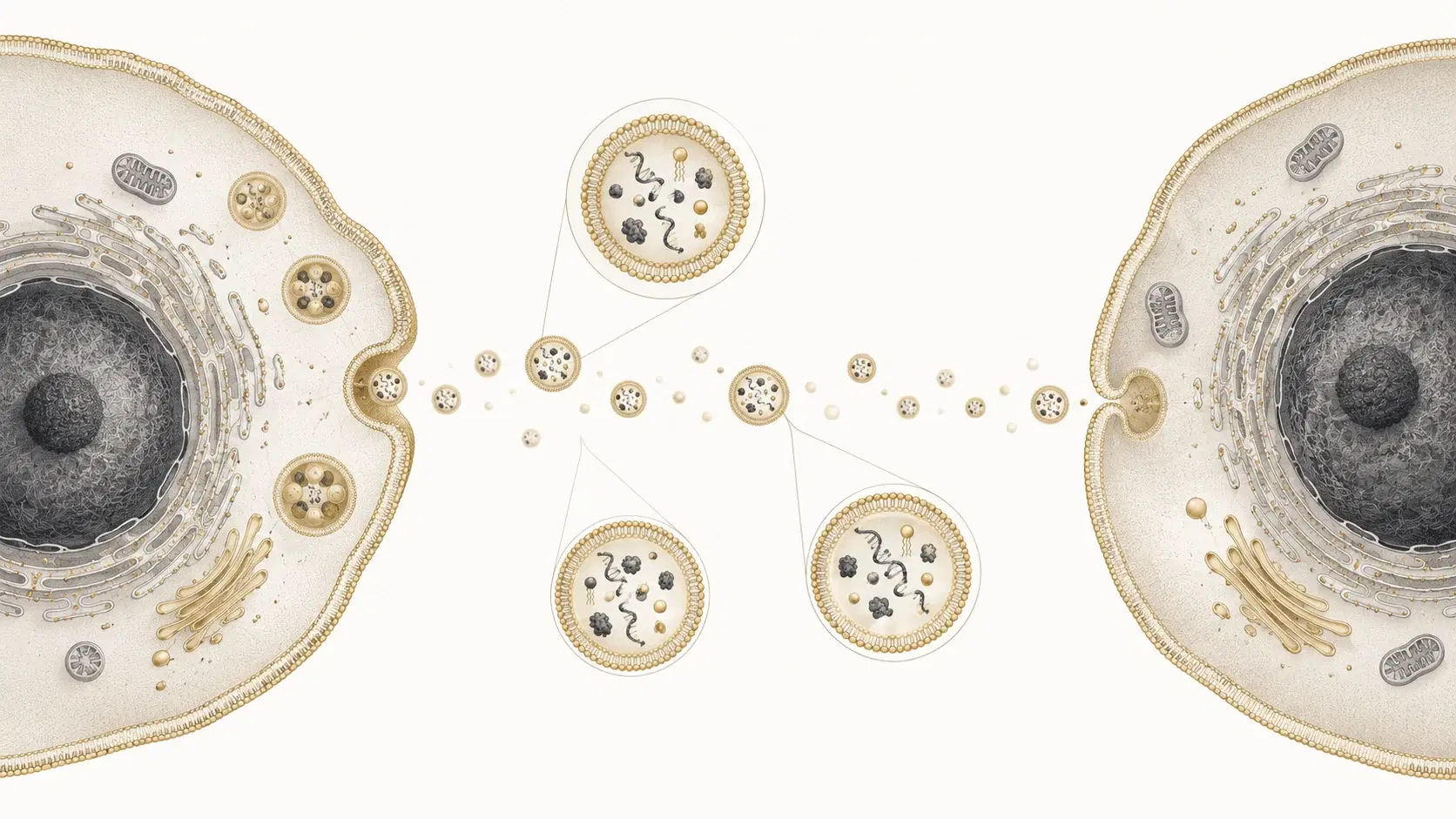
That is the promise behind exosome therapy. Exosomes are one class within the broader family of extracellular vesicles, or EVs: membrane-bound particles through which cells can transfer proteins, lipids and genetic material.
But excitement has created a shortcut: the assumption that "exosomes" are one uniform treatment.
They are not.
The real questions are more exacting: Which EVs? From which source cells? Carrying what cargo? Produced under which conditions? Delivered by which route? For which indication, and measured against which outcome?
Those questions may decide whether EV-based medicine becomes a credible therapeutic platform or another promising field weakened by claims that moved faster than the evidence.
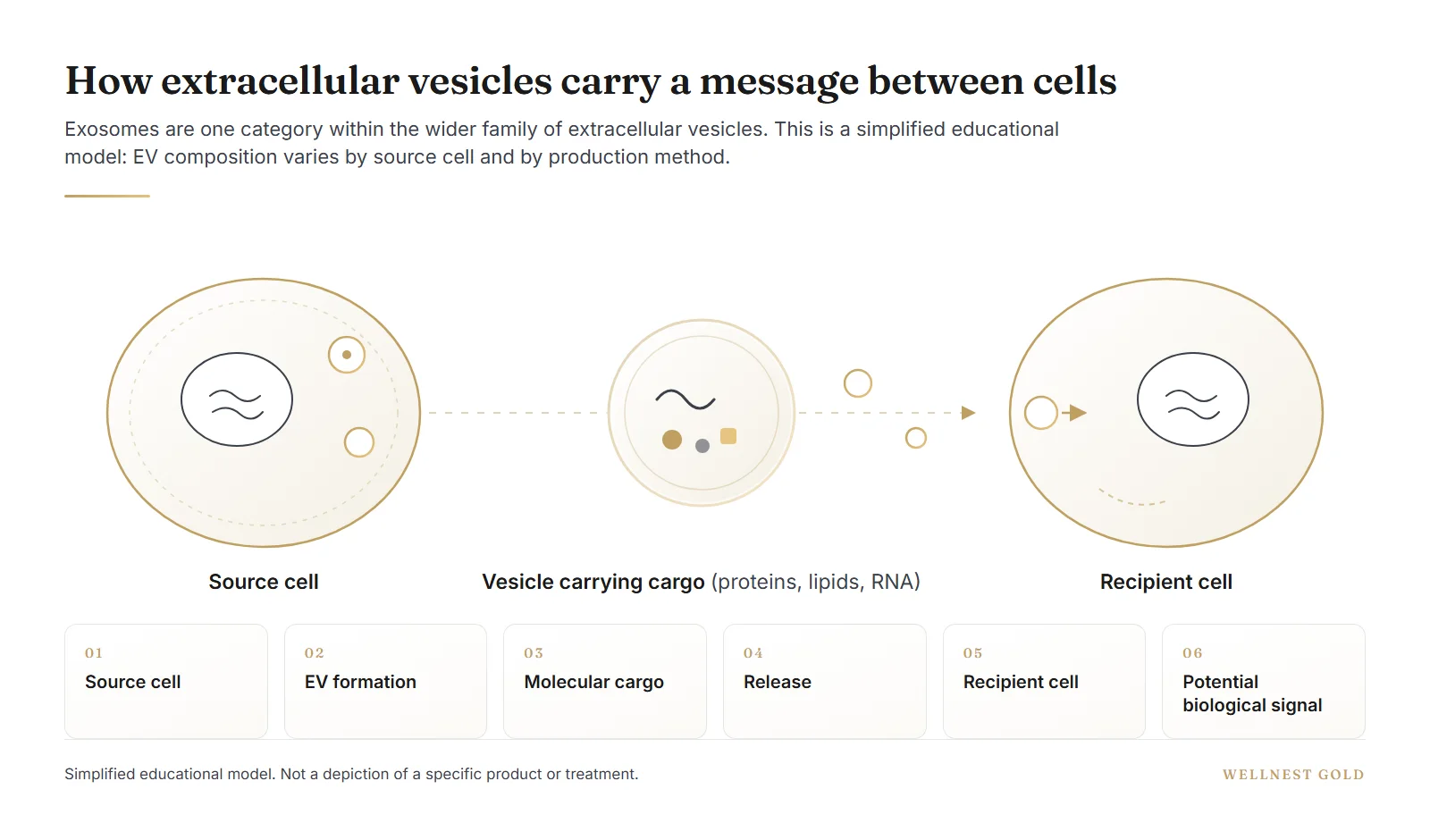
Simplified educational model. EV composition varies by source cell and by production method.
The first breakthrough is not a therapy. It is a definition.
The International Society for Extracellular Vesicles recommends using the umbrella term extracellular vesicle unless a particle's specific biogenesis has been demonstrated. "Exosome" should be retained where the research has adequately established that identity.[1]
This is not scientific pedantry. It is product definition.
Two preparations can carry the same label while differing in cellular source, isolation method, purity, dose and biological activity. Precision in language is the beginning of precision in medicine.
Then the evidence became genuinely interesting
In 2025, researchers led by Valerie S. Kalluri and Raghu Kalluri reported a first-in-human Phase I study of engineered exosomes carrying RNA designed to silence mutant KRAS-G12D in advanced pancreatic cancer.[2]
The small, non-randomised, single-centre trial was designed primarily to assess tolerability, dosing and target engagement, not survival.
No dose-limiting toxicity or treatment-related adverse events were reported at the doses tested. The maximum tolerated dose was not reached, and molecular evidence of KRAS-pathway suppression was documented. Several participants experienced periods of stable disease, although most later progressed.
That is encouraging.
It is also unmistakably early-stage evidence. The study does not establish a survival benefit or prove clinical efficacy.
A separate 2025 Phase I study randomised 24 patients with pulmonary fibrosis to routine treatment plus nebulised umbilical-cord mesenchymal-stromal-cell EVs, or routine treatment plus a saline control.[3]
The investigators reported no serious treatment-related adverse events during the study, and several respiratory measures improved. Yet each group contained only 12 people.
The conclusion is not that efficacy has been established. It is that the early clinical signal deserves larger, independently replicated trials.
The contradiction is the point
Respiratory research shows why disciplined interpretation matters.
A 2024 double-blind randomised trial involving 45 critically ill patients with COVID-associated acute respiratory distress syndrome reported hospital mortality of 19.0% in the EV group versus 54.2% in controls.[4]
That result is striking.
But a larger 102-patient randomised trial of a different bone-marrow-derived EV preparation did not show a statistically significant reduction in 60-day mortality in the full intention-to-treat population. A favourable result appeared only in a subsequent post-hoc subgroup analysis.[5]
These studies do not simply cancel one another out.
They reveal the central challenge: EV preparations are not interchangeable. Source, manufacturing method, dose, route and patient selection can all change the result.
The contradiction is not science failing. It is science becoming more specific.
The market arrived before the medicine
The public most often encounters exosome claims through hair restoration, skin rejuvenation, wound care and orthopaedics. Some early findings are promising.
But plausibility is not proof.
A review of human hair-loss research identified nine clinical studies involving 125 patients who received exosome-based treatment.[6] The authors found limited evidence, inconsistent methods and a need for larger controlled trials, longer follow-up and standardised manufacturing. Serious adverse events have also been reported within the wider dermatological use of products marketed as containing exosomes.
A 2026 periodontal study reported favourable six-month outcomes in 13 patients.[8] But it was retrospective, lacked a comparator and combined an exosome product with bone material and platelet-rich fibrin.
It therefore could not establish what the exosome component contributed independently.
This is the difference between a signal and a conclusion. Responsible medicine must preserve it.
A vial is not an evidence category
As of January 2025, researchers had registered 292 EV-related studies on ClinicalTrials.gov.[7]
Among the 117 therapeutic interventional studies:
73% were in Phase I or Phase II;
94% involved naturally derived EVs; and
only 6% involved engineered EVs.
That is a serious scientific pipeline.
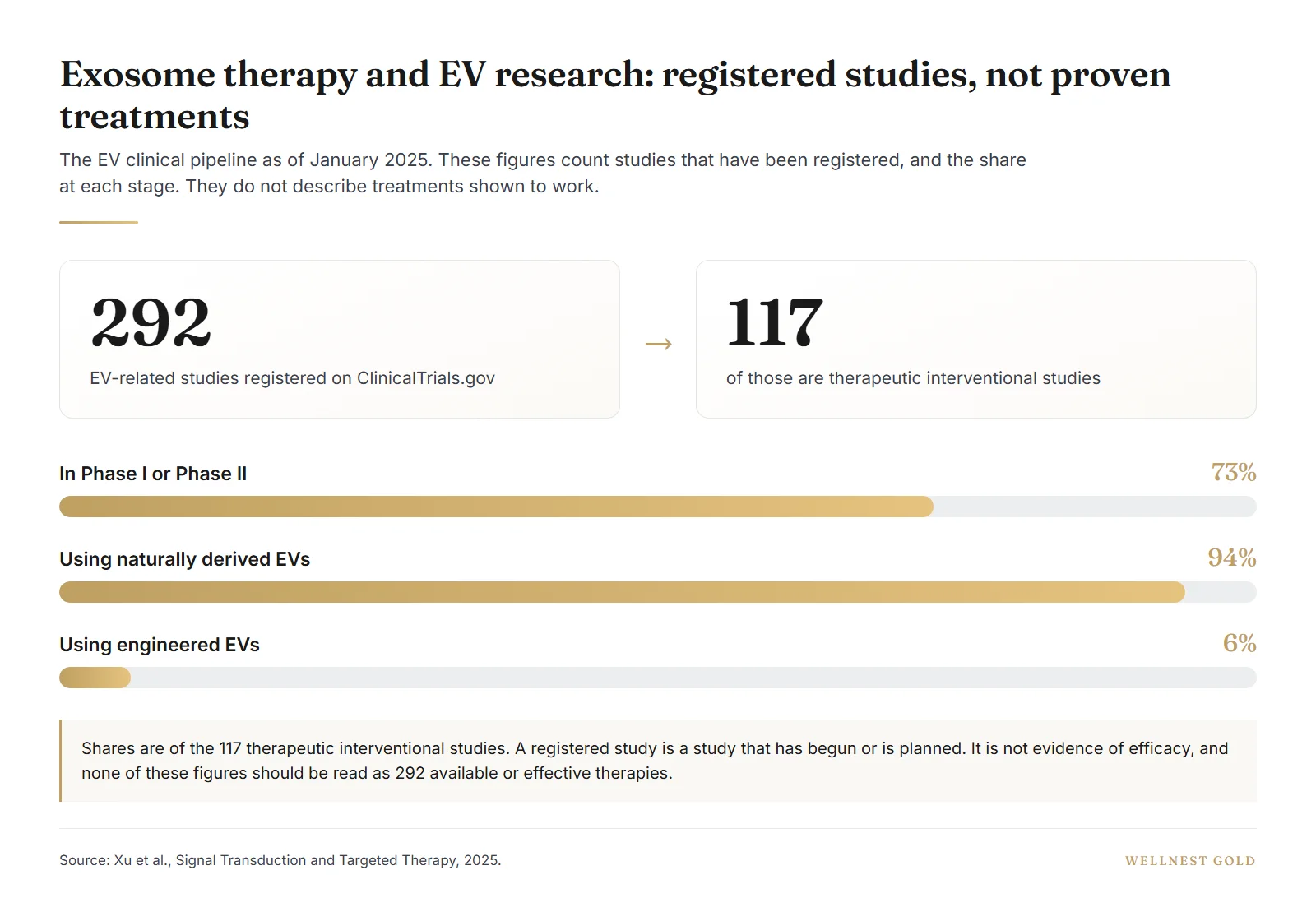
Source: Xu et al., Signal Transduction and Targeted Therapy, 2025. These are registered studies, not treatments shown to be effective.
It is also predominantly early-stage. Registered studies are not demonstrated treatments.
Manufacturing may prove as important as mechanism. Donor selection, source cell, culture conditions, isolation, storage, particle concentration, purity, potency and batch consistency can all influence the final preparation.
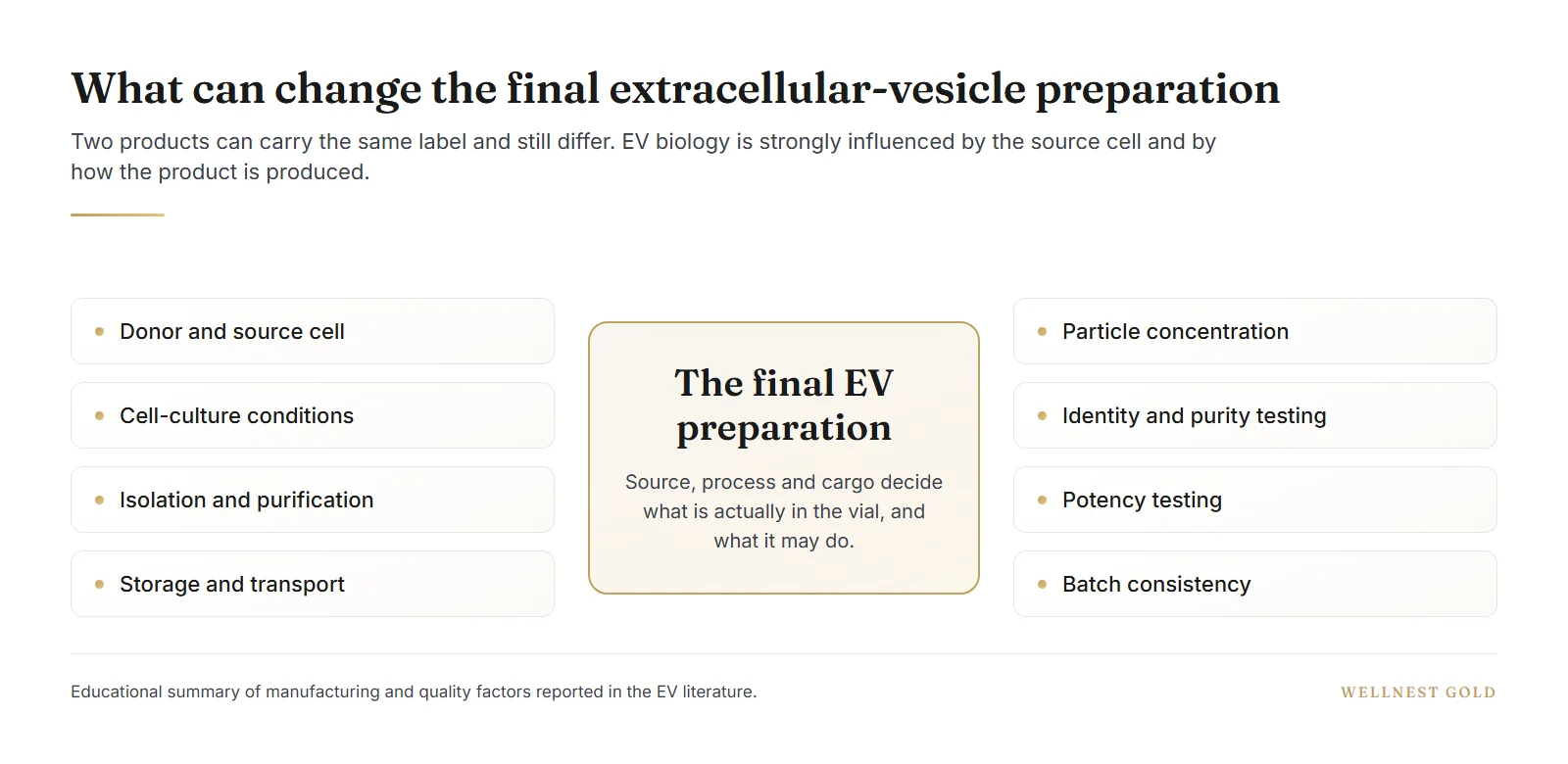
Educational summary of the manufacturing and quality factors reported in the extracellular-vesicle literature.
EV biology is strongly influenced by the source cell and by how the product is produced.
That point cuts both ways. EVs are not inherently regenerative or beneficial. Tumour-derived exosomes, for example, have been shown in preclinical research to suppress aspects of immune function and support tumour immune escape.[9]
Source matters. Process matters. Cargo matters.
Exosome therapy and EV human trials at a glance
Indication | Study design | Participants | EV or exosome preparation | Main reported finding | Principal limitation |
|---|---|---|---|---|---|
Advanced pancreatic cancer (KRAS-G12D) | First-in-human Phase I, non-randomised, single centre | Small single-centre cohort | Engineered exosomes carrying siRNA against mutant KRAS-G12D | No dose-limiting toxicity or treatment-related adverse events at the doses tested; molecular evidence of KRAS-pathway suppression; some periods of stable disease | Early-stage evidence. The study does not establish a survival benefit or prove clinical efficacy |
Pulmonary fibrosis | Phase I randomised, saline control | 24 (12 per group) | Nebulised umbilical-cord mesenchymal-stromal-cell EVs | No serious treatment-related adverse events were reported in that study; several respiratory measures improved | Twelve people per group. Too small to establish efficacy |
COVID-associated acute respiratory distress syndrome | Double-blind randomised controlled trial | 45 | Placental mesenchymal-stromal-cell small EVs | Hospital mortality 19.0% in the EV group versus 54.2% in controls | Single trial, small sample, and not replicated in the larger trial below |
Respiratory failure from COVID-19 | Randomised controlled trial | 102 | Bone-marrow mesenchymal-stem-cell-derived EVs | No statistically significant reduction in 60-day mortality in the full intention-to-treat population | The favourable result appeared only in a post-hoc subgroup analysis |
The future will be earned, not announced
Regulatory status differs by jurisdiction. In the United States, the FDA has repeatedly warned against unapproved exosome products and has continued enforcement against companies marketing them as unapproved drugs and biological products.[10]
Most EV and exosome therapies remain investigational rather than standard treatment.
That does not make the field irrelevant. It makes disciplined clinical governance essential.
Before considering any EV-based intervention, five questions should be unavoidable:
What exactly is the product? How was it manufactured and released? What human evidence supports this indication and route? Under what regulatory and ethical framework is it being used? And how will outcomes and adverse events be measured over time?
At WellNest, our position is simple: emerging science should sit within physician oversight, transparent evidence, longitudinal diagnostics and structured follow-up, not be sold as certainty or treated as an isolated event. Clinical oversight at WellNest is led by Dr Raythaan Addinall, Medical Practitioner, Preventive Medicine and Longevity.
Exosomes and other EVs may become precision-delivery vehicles, cell-free biologics and important tools in regenerative and immune medicine.
But their greatest test is not whether we can make them sound revolutionary.
It is whether we can build evidence strong enough that we no longer need to.
Related reading
Explore our clinical review of Muse cells and Muse-derived exosomes.
Further evidence reviews are collected on the WellNest blog.
Understand your health before choosing an intervention
Start with a physician-led assessment built around your history, biomarkers and long-term objectives.
Explore the Baseline 360 Assessment
Educational and medical disclaimer
This article is educational and does not replace individual medical advice. Evidence, suitability and regulatory status vary by product, indication and jurisdiction. No treatment decision should be made without an appropriately qualified medical practitioner reviewing the individual patient, proposed product and applicable regulatory framework.