



An educational perspective, based on evidence available on 7 September 2026.
Key takeaways
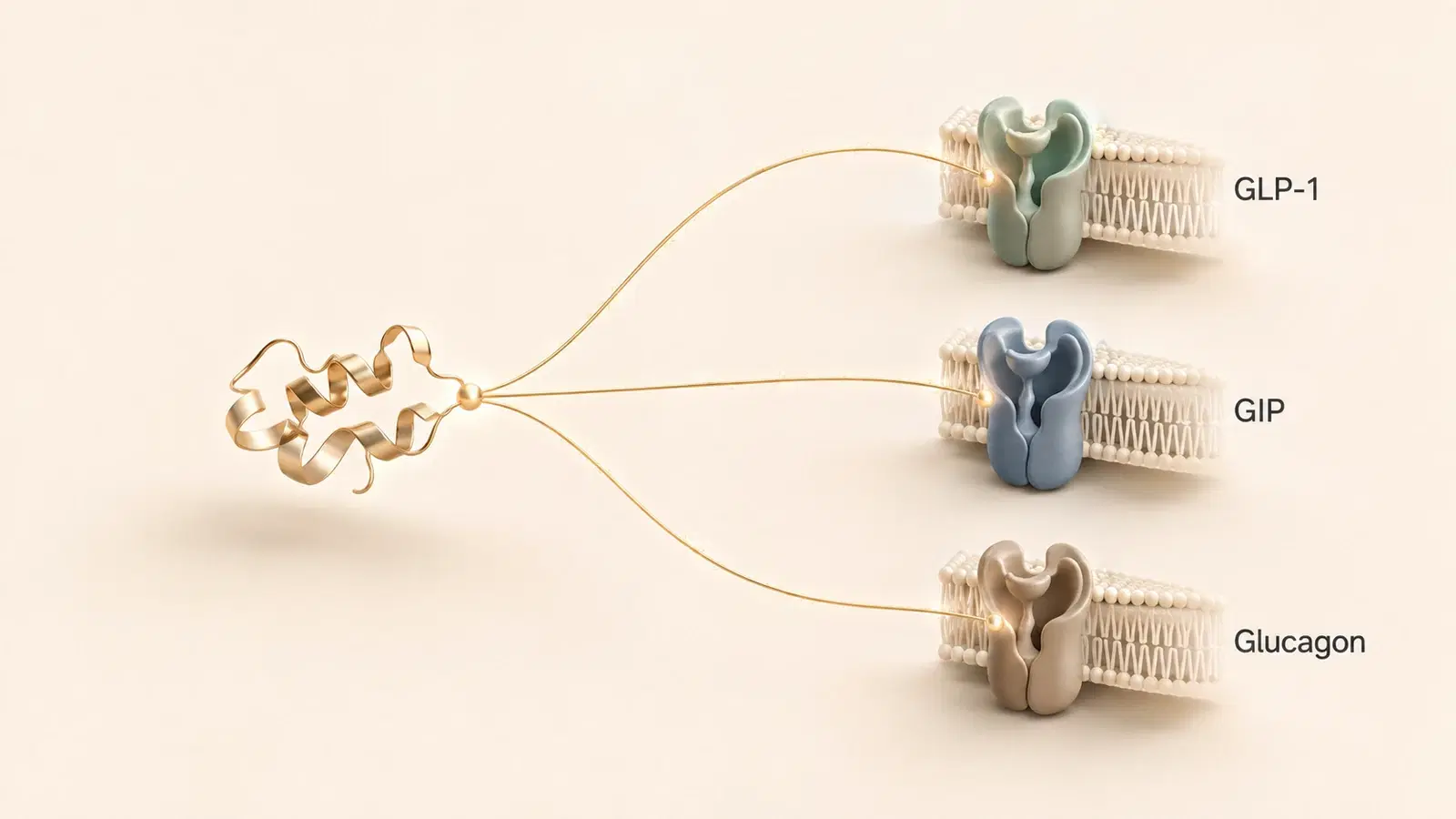
What is retatrutide? Retatrutide (LY3437943) is an investigational triple hormone receptor agonist developed by Eli Lilly. It activates the GLP-1, GIP and glucagon receptors at the same time.
How effective is it? Phase 3 trials have reported average weight loss of up to 28.3% at 80 weeks (TRIUMPH-1) and HbA1c reductions of up to 1.94 percentage points in type 2 diabetes (TRANSCEND-T2D-1).
Benefits beyond weight: early signals in knee osteoarthritis pain, obstructive sleep apnoea and liver fat, where a Phase 2a study reported an 82.4% relative reduction.
Regulatory status: not approved. Retatrutide remains an investigational medicine in clinical trials. It is not registered by the FDA, the EMA or SAHPRA, and products sold online or compounded as "retatrutide" are unauthorised and potentially unsafe.
Imagine finishing dinner and simply feeling finished. No prolonged negotiation with hunger. No sense that maintaining your weight requires fighting your own body every day.
That possibility helps explain the intense global interest in a new generation of GLP-1 receptor agonist medications that influence appetite and metabolism. They are changing what people expect from weight management, and prompting difficult questions about who gets access, what treatment should cost, and how much confidence to place in the promises.
Retatrutide is currently one of the most closely watched developments in metabolic medicine. By July 2026, its developer, Eli Lilly, had reported positive results from five Phase 3 trials. Yet it remains an investigational drug. Understanding how something can be scientifically exciting while still awaiting regulatory approval is essential to understanding its story.[1]
What is retatrutide and how does GLP-1 science work?
The story begins with a hormone your body already makes.
GLP-1 stands for glucagon-like peptide-1. Released in response to food, it helps coordinate what happens after a meal:
Stimulating insulin secretion when blood sugar is elevated.
Slowing the movement of food through the stomach (gastric emptying).
Participating in brain signalling pathways that regulate hunger and satiety.
Medicines commonly called "GLP-1s" activate this natural signalling system. They can make eating less feel more manageable by changing the underlying biological signals.[2]
The pioneers behind hormone discovery
Nobody invented the hormone. Discovering its significance and turning that discovery into useful medicines took decades:
1980s breakthroughs: researchers including Joel Habener, Svetlana Mojsov, Daniel Drucker and Jens Juul Holst helped establish GLP-1's identity and metabolic effects. Mojsov's work was critical in identifying its active physiological form.[2]
Overcoming the half-life problem: Lotte Bjerre Knudsen and colleagues resolved a major obstacle. Natural GLP-1 disappears from the bloodstream within minutes, and a practical medicine needed to remain active for far longer.[3]
The Gila monster connection: John Eng and Jean-Pierre Raufman discovered exendin-4 in Gila monster venom. Its ability to mimic GLP-1 led directly to exenatide, the first GLP-1 receptor agonist approved by the US FDA, in 2005.[4]

The Gila monster, whose venom yielded exendin-4 and, from it, the first GLP-1 medicine. Illustrative image.
Why retatrutide is called a "triple agonist" (and the myth of "GLP-3")
Retatrutide emerged from a later chapter in pharmaceutical engineering: targeting multiple hormone pathways within a single molecule.
Developed by Eli Lilly under the research name LY3437943, its 2022 discovery paper was authored by Tamer Coskun, Shweta Urva and a multidisciplinary team of Lilly scientists.[5]
Clearing up the "GLP-3" misnomer
You may encounter the nickname "GLP-3". It is scientifically inaccurate. The correct description for retatrutide is a triple hormone receptor agonist. An agonist activates a cell receptor to produce a biological response. Retatrutide activates the receptors for three distinct hormones:
GLP-1 (glucagon-like peptide-1): regulates appetite, satiety and glucose-dependent insulin release.
GIP (glucose-dependent insulinotropic polypeptide): enhances the nutrient response and the efficiency of lipid storage, and works in synergy with GLP-1.
Glucagon: influences energy expenditure and hepatic glucose output.
Receptor activated by retatrutide | Natural hormone | Main effects of activation |
|---|---|---|
GLP-1 receptor | Glucagon-like peptide-1 | Reduces appetite; slows gastric emptying; glucose-dependent insulin release |
GIP receptor | Glucose-dependent insulinotropic polypeptide | Enhances the insulin response; works in synergy with GLP-1 |
Glucagon receptor | Glucagon | Increases energy expenditure |
Glucagon's inclusion is particularly novel. Native glucagon raises blood glucose, but balancing its action against GLP-1 and GIP signalling allows researchers to harness its energy-expenditure benefits without causing hyperglycaemia. In early mouse studies, glucagon receptor activation significantly boosted metabolic rate. The exact share of calorie burn it contributes in humans remains an active research question.[5]
Retatrutide clinical trial results: Phase 2 vs Phase 3
Clinical evidence for retatrutide has progressed rapidly across several key trials:
Trial | Phase | Population | Highest-dose weight loss | Key secondary outcome | Status |
|---|---|---|---|---|---|
Phase 2 study (NEJM, 2023) | Phase 2 | 338 adults with obesity | 24.2% at 48 weeks | Dose-dependent efficacy confirmed | Published, The New England Journal of Medicine, 2023 |
TRANSCEND-T2D-1 | Phase 3 | 537 adults with type 2 diabetes | 15.3% at 40 weeks | HbA1c reduced by 1.94 percentage points | Published, The Lancet, June 2026 |
TRIUMPH-1 | Phase 3 | 2,339 adults with obesity or overweight | 28.3% at 80 weeks | Waist circumference and cardiovascular risk markers improved | Company topline results, May 2026; not yet peer reviewed |
TRIUMPH-2 | Phase 3 | 1,152 adults with type 2 diabetes and obesity or overweight | 20.8% at 80 weeks | HbA1c reduced by up to 1.6 percentage points | Company topline results, July 2026; not yet peer reviewed |
TRIUMPH-3 | Phase 3 | 1,949 adults with severe obesity and established cardiovascular disease | 22.6% at 80 weeks | Too few cardiovascular events to draw conclusions | Company topline results, July 2026; not yet peer reviewed |
TRIUMPH-4 | Phase 3 | 445 adults with obesity or overweight and knee osteoarthritis | 28.7% at 68 weeks | Knee pain reduced by 4.4 points on a 10-point scale | Company topline results, December 2025; not yet peer reviewed |
Phase 2 milestone (2023)
A Phase 2 trial published in the New England Journal of Medicine reported an average weight loss of 24.2% after 48 weeks at the highest dose studied (12 mg), compared with 2.1% on placebo.[6]
Phase 3 diabetes data: TRANSCEND-T2D-1
Published in The Lancet in June 2026, this trial evaluated 537 adults with type 2 diabetes inadequately controlled by diet and exercise:[7]
Weight reduction: 15.3% average reduction on the treatment-regimen estimand, and up to 16.8% on the efficacy estimand, versus 2.6% for placebo.
Glycaemic control: HbA1c fell by 1.94 percentage points, versus 0.81 points on placebo.
Phase 3 obesity data: TRIUMPH-1 and health outcomes
In the 80-week TRIUMPH-1 trial of 2,339 participants, Lilly reported an average weight reduction of 28.3% at the highest dose on the efficacy estimand, which estimates the effect had every participant stayed on treatment. To put that into perspective, a 28% drop for someone starting at 100 kg is a 28 kg loss.[8]
Health benefits beyond weight loss
Clinical interest extends well beyond body composition alone:
Knee osteoarthritis (TRIUMPH-4): participants on the 12 mg dose reported a 4.4-point reduction in knee pain on a 10-point scale, versus 2.4 points for placebo, along with marked improvements in physical function.[9]
Obstructive sleep apnoea: in the TRIUMPH-1 sleep apnoea sub-study, retatrutide reduced the apnoea-hypopnoea index by up to 36.1 events per hour, a 60.6% reduction, in adults with moderate-to-severe sleep apnoea.[10]
Liver fat: a Phase 2a study published in Nature Medicine reported an average 82.4% relative reduction in liver fat, measured by MRI, at 24 weeks on the highest dose.[11]
An important evidence distinction. Semaglutide has proven cardiovascular risk reduction: in the landmark SELECT trial it cut major adverse cardiovascular events by 20%.[12] Retatrutide has not yet shown the same. TRIUMPH-3 enrolled adults with severe obesity and established cardiovascular disease, but it was not designed as a cardiovascular outcomes trial. Events were fewer than expected in both arms and the confidence interval around the hazard ratio crossed 1, so the result is inconclusive. Retatrutide has not yet been shown to prevent heart attacks or strokes.[1]
Side effects, safety and long-term considerations
High-potency metabolic medicines require careful assessment of safety, side effects and adherence.
1. Gastrointestinal and skin-related side effects
In the TRIUMPH-1 trial:[8]
Nausea: reported by 42.4% of participants on the highest dose, versus 14.8% on placebo.
Discontinuation: adverse events led 11.3% of participants on the highest dose to stop treatment, versus 4.9% on placebo.
Other reported events included diarrhoea, vomiting, constipation and unusual skin sensations (dysaesthesia).
2. Muscle mass and nutritional balance
Rapid weight loss carries a risk of losing lean tissue alongside fat. Clinical guidance strongly emphasises combining medication with adequate nutrition and resistance exercise to preserve muscle mass and functional strength.[13]
3. The chronic disease model and discontinuation
Evidence from tirzepatide weight loss and withdrawal studies, including the SURMOUNT-4 trial, shows that stopping receptor agonist treatment typically leads to significant weight regain. Obesity is increasingly managed as a chronic biological condition that needs a long-term care plan.[14]

Nutrition, resistance training and long-term follow-up stay the foundation, with or without medication.
Pricing, regulatory status and unapproved product warnings
Is retatrutide approved?
No. Retatrutide is an unapproved, investigational compound still in clinical development. It is not approved by the US FDA, the European Medicines Agency (EMA), SAHPRA or any other medicines regulator. Lilly has said it plans to submit retatrutide to the FDA in the first quarter of 2027.[1]
Regulatory warning on unapproved and compounded "retatrutide". The US FDA has stated that retatrutide cannot lawfully be compounded, and has issued warning letters to sellers of products marketed as retatrutide.[15][16] SAHPRA has warned South Africans about unregistered peptide products, including GLP-1 medicines, sold through websites, gyms and informal channels.[17] Compounded or "research" versions carry serious risks around chemical identity, sterility, dosing accuracy and harmful impurities.

Unregistered or compounded products sold as "retatrutide" have no verified identity, sterility or dose. Illustrative image, not a product photograph.
For detailed guidance on the risks of unapproved peptides, see our resource on unapproved GLP-1 drug risks and compounding warnings.
The pricing and global access debate
As metabolic medicines evolve, the debate over affordability and health equity continues. A US Senate committee hearing in September 2024 put global price disparities in the spotlight,[18] while the World Health Organization's first guideline on GLP-1 therapies for obesity, published in December 2025, stresses the balance between funding innovation and ensuring equitable access to care.[19]
Frequently Asked Questions
What makes retatrutide different from Ozempic and Mounjaro?
Ozempic (semaglutide) targets one hormone receptor, GLP-1. Mounjaro (tirzepatide) targets two, GLP-1 and GIP. Retatrutide (LY3437943) targets three: GLP-1, GIP and glucagon. That makes it a triple agonist, with potential effects on energy expenditure as well as appetite.
When will retatrutide be commercially available?
Retatrutide is in Phase 3 clinical trials. Eli Lilly has said it plans to submit a Biologics License Application (BLA) to the US FDA in the first quarter of 2027. Commercial availability depends on regulatory review and approval, and availability in South Africa would additionally depend on SAHPRA registration.
How much weight do patients lose on retatrutide?
Retatrutide weight loss in the TRIUMPH-1 Phase 3 trial averaged 28.3% of body weight at 80 weeks on the highest dose, on the efficacy estimand, which assumes continuous treatment. Individual responses in clinical practice will vary.
Medical disclaimer
This article provides general educational information and is not personal medical advice. Retatrutide is an investigational medicine that is not registered in South Africa or anywhere else, and WellNest does not prescribe, supply or source it. Consult an appropriately registered healthcare professional before starting, stopping or changing any treatment. Results vary.
This article is scheduled for editorial review within 6 months, or sooner if the evidence or the regulatory position changes.