



You're not lazy. You're not "just getting older". And you're definitely not imagining it.
If you're dragging yourself through afternoons, losing more hair in the shower than seems fair, getting breathless on a single flight of stairs, or falling asleep on the couch by 20:30, your body may simply be running short of one mineral: iron.
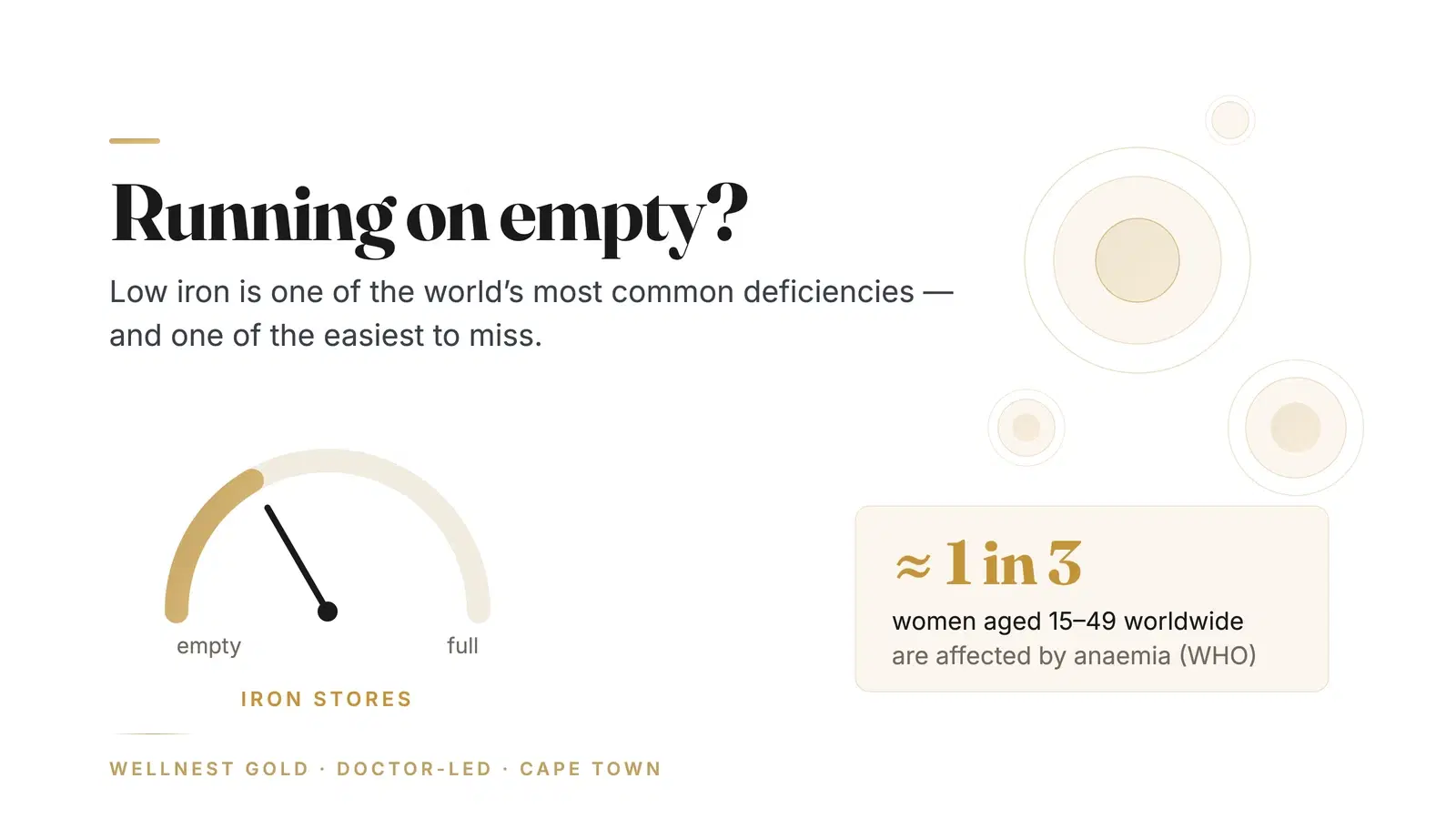
It's staggeringly common. The World Health Organization estimates that anaemia affects about 30% of women aged 15 to 49 worldwide, over half a billion women, and iron deficiency is its leading cause.[1] It is widely regarded as the most common nutritional deficiency on earth.[2] Yet most people push through it for months or years, because the symptoms are easy to blame on stress, work, parenting, or "just life".
This guide walks through what iron deficiency actually is, the signs your body sends, the blood tests that settle the question, and the honest answer to the question that probably brought you here: when is an iron infusion actually the right fix, and when isn't it?
What is iron deficiency, and what causes it?
Iron is the raw material for haemoglobin, the protein in red blood cells that carries oxygen from your lungs to every muscle and organ. When iron runs low, your body literally delivers less oxygen per heartbeat. That's why the symptoms feel like someone turned your power down.
Iron deficiency doesn't arrive overnight. It develops in three stages:
Iron depletion. Your stores (measured as ferritin) drain first. Haemoglobin still looks normal, but symptoms like fatigue and hair shedding can already begin here.
Iron-deficient erythropoiesis. Stores are near empty and your body starts struggling to build healthy red blood cells.
Iron-deficiency anaemia. Haemoglobin finally drops. This is the stage most standard check-ups catch, often long after you started feeling awful.
That middle ground, low ferritin with "normal" haemoglobin, is exactly why many people are told "your bloods are fine" while feeling anything but. Iron deficiency without anaemia is real, common, and treatable.[2]
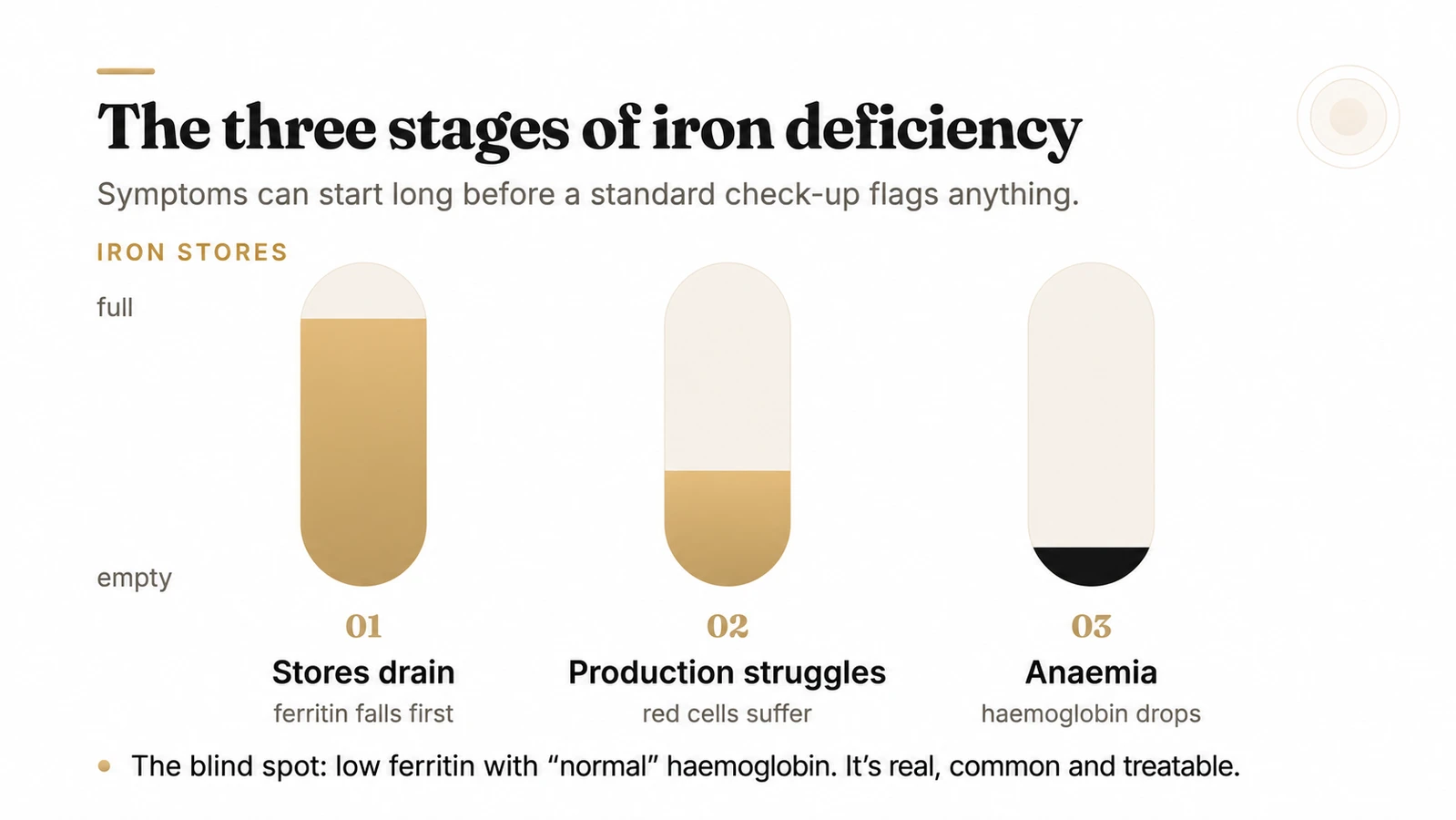
The three stages of iron deficiency. Symptoms can begin at stage one, while standard check-ups often only flag stage three.
The usual causes are less mysterious than people fear:
Heavy periods, the single most common cause in women.
Pregnancy and breastfeeding, where demand simply outpaces supply.
Diet, meaning low intake of iron-rich foods, or plant-based eating without deliberate iron planning.
Absorption problems such as coeliac disease, gut inflammation, previous gut surgery, or long-term use of certain reflux medications.
Ongoing blood loss, including from the gut, which is precisely why unexplained iron deficiency should always be assessed by a doctor rather than quietly self-treated.
Endurance training, where athletes lose iron through sweat, impact and inflammation.
Signs of low iron: what your body is telling you
Low iron rarely announces itself with one dramatic symptom. It whispers, in combinations:
Fatigue that sleep doesn't fix, the signature symptom.
Breathlessness on stairs or hills that never used to cost you anything.
Pale skin, pale inner eyelids, washed-out lips.
Hair shedding and brittle, spooning or ridged nails.
Cold hands and feet, even in a Cape Town summer.
Brain fog, meaning poor concentration, low mood, shortened patience.
Restless legs at night.
Heart palpitations or a pounding heartbeat after mild effort.
Strange cravings, most classically ice, a phenomenon called pica.
Milder cases may only show one or two of these, which is why low iron hides so well behind "burnout". At the severe end, iron-deficiency anaemia can cause chest pain, dizziness or fainting, symptoms that need prompt, same-day medical care, not a blog post.
If several of the quieter signs feel familiar, the next step isn't guessing, it's measuring.

Low iron rarely presents as one symptom. It shows up in combinations.
How do you know for sure? The blood tests that settle it
Here's the part most people get backwards: they buy supplements first and test never. That's a mistake for three reasons. The fatigue might not be iron at all, since thyroid problems, B12 deficiency, sleep and more can mimic it. Iron overload is genuinely harmful, so "more" is not automatically better.[2] And unexplained deficiency sometimes has a cause that needs finding.
Three tests tell most of the story:
Ferritin, your iron storage gauge, and usually the first number to fall.
Full blood count, covering haemoglobin and red-cell health.
Iron studies, meaning serum iron and transferrin saturation: how iron is moving and being used.
A doctor reads these together with your symptoms and history, because a ferritin level that's fine for one person can be the whole explanation for another's exhaustion.
This is exactly how WellNest structures it: bloods first. You have the right tests done, ferritin, a full blood count and iron studies, billed separately by the lab, or you bring recent results. A doctor reviews them, then meets you for a 15-minute, R550 doctor consultation, in person on Bree Street or online, to assess your results alongside your symptoms. No packages sold on day one. Measurement first. You can read how the iron infusion consultation in Cape Town works before booking, and if you want the wider case for measuring rather than guessing, see our guide to advanced blood testing.
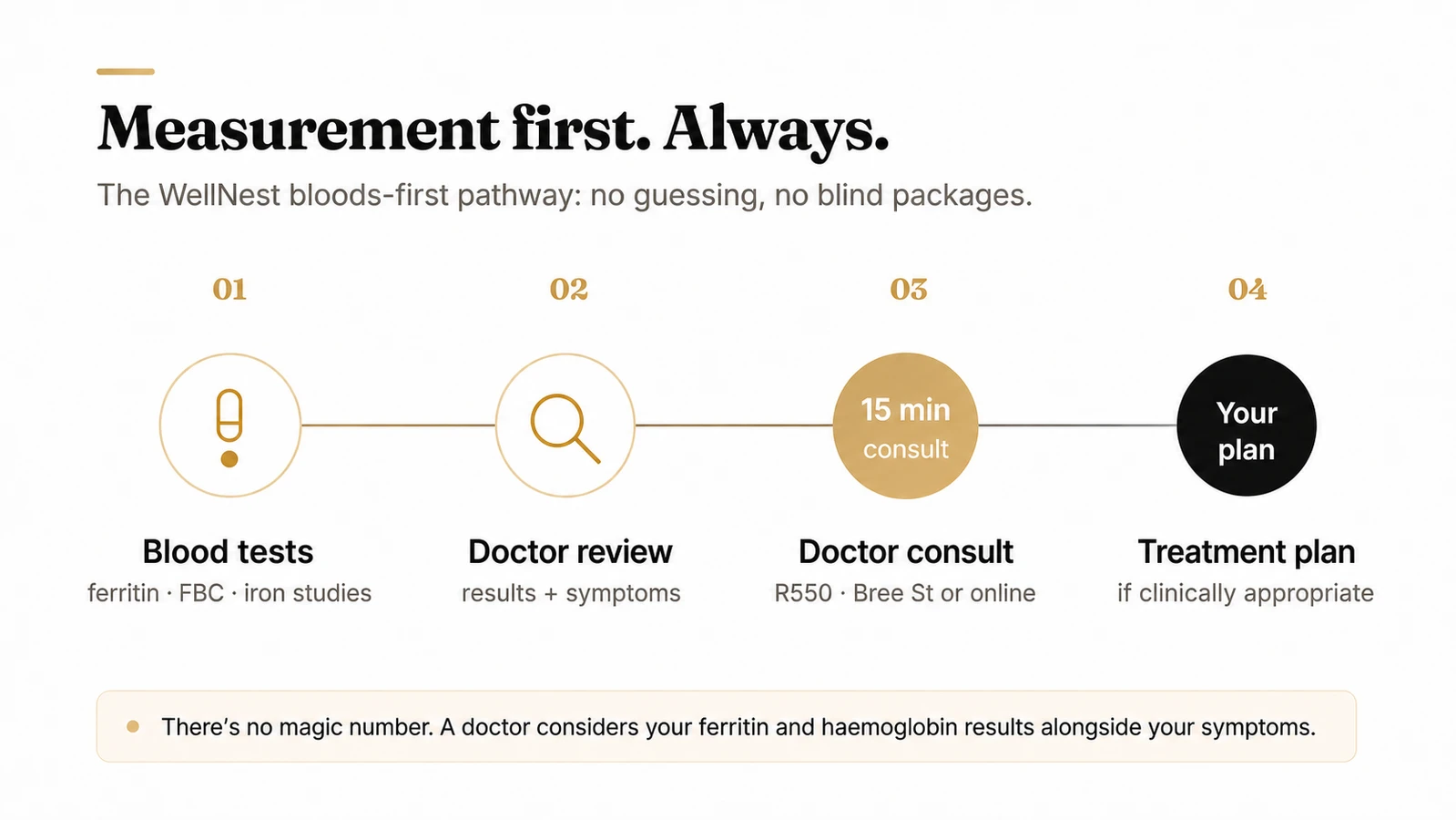
The WellNest bloods-first pathway. An infusion is considered only after a doctor has reviewed your results.
Fixing low iron: food, tablets, and when an IV infusion makes sense
Think of treatment as a ladder, matched to how deep the deficiency runs and how your body cooperates.
1. Food first, for prevention and mild shortfalls. Red meat, liver, sardines, eggs, legumes, dark leafy greens. Vitamin C alongside plant iron helps absorption, while tea and coffee with meals work against it.[2] Food maintains iron well, but it rebuilds truly depleted stores slowly.
2. Oral iron, the standard first treatment. Tablets work for many people and are usually tried first. The honest catch: iron tablets are famously hard on some stomachs, causing nausea, cramping and constipation, and rebuilding stores takes months of consistency.[2] A meaningful number of people either can't tolerate them or can't absorb them.
3. IV iron, for when tablets fail, aren't tolerated, or time matters. An intravenous iron infusion delivers iron directly into the bloodstream, bypassing the gut entirely. Doctors consider it when oral iron hasn't worked or can't be used, when absorption is the underlying problem, when deficiency is severe, or when iron needs restoring faster than tablets allow, for example ahead of surgery, or in later pregnancy under specialist guidance.[3]
So what iron level "requires" an infusion? Here's the truthful answer most websites dodge: there is no single magic number. Two people with the same ferritin can need entirely different plans. A doctor weighs ferritin, haemoglobin, iron studies, symptoms, history and cause together, which is why at WellNest an infusion is never sold off a menu. It is considered only after a doctor has reviewed your bloods, and only when clinically appropriate.
What actually happens during an iron infusion
If your doctor does recommend one, here's the honest picture, because "IV iron" sounds more dramatic than it usually is.
Before: eat normally, hydrate, take your usual medication unless told otherwise, wear something with easy arm access.
During: a small cannula goes into a vein in your arm or hand, and the iron runs in, typically over 15 to 60 minutes depending on the preparation your doctor selects. Most people read, work on a laptop, or just enjoy being made to sit still.
After: you're observed for a short period, then most people head straight back to their day. Driving afterwards is generally fine unless you feel unwell or were told otherwise. Give strenuous exercise a miss for the rest of the day, and don't panic about mild, short-lived after-effects: a headache, mild nausea, or achy muscles and joints a day or two later, flu-ish feelings that pass. Contact your doctor promptly if anything feels more than mild.
The balanced truth about risk: modern IV iron is considered safe under medical supervision, and that qualifier is the point. Allergic reactions are uncommon but real, which is why infusions belong in a clinical setting with a doctor, not at home.[3] A rare but permanent risk worth knowing: if iron leaks outside the vein it can stain the skin, which is why slow, monitored administration matters.
And the payoff? Iron levels rise quickly, but bodies rebuild on their own schedule. Most people notice energy improving over days to a few weeks, with follow-up bloods confirming the trend. How many infusions you need depends on how depleted you were and the preparation used, and many people need only one or two. Your doctor will tell you your number, not the internet's.
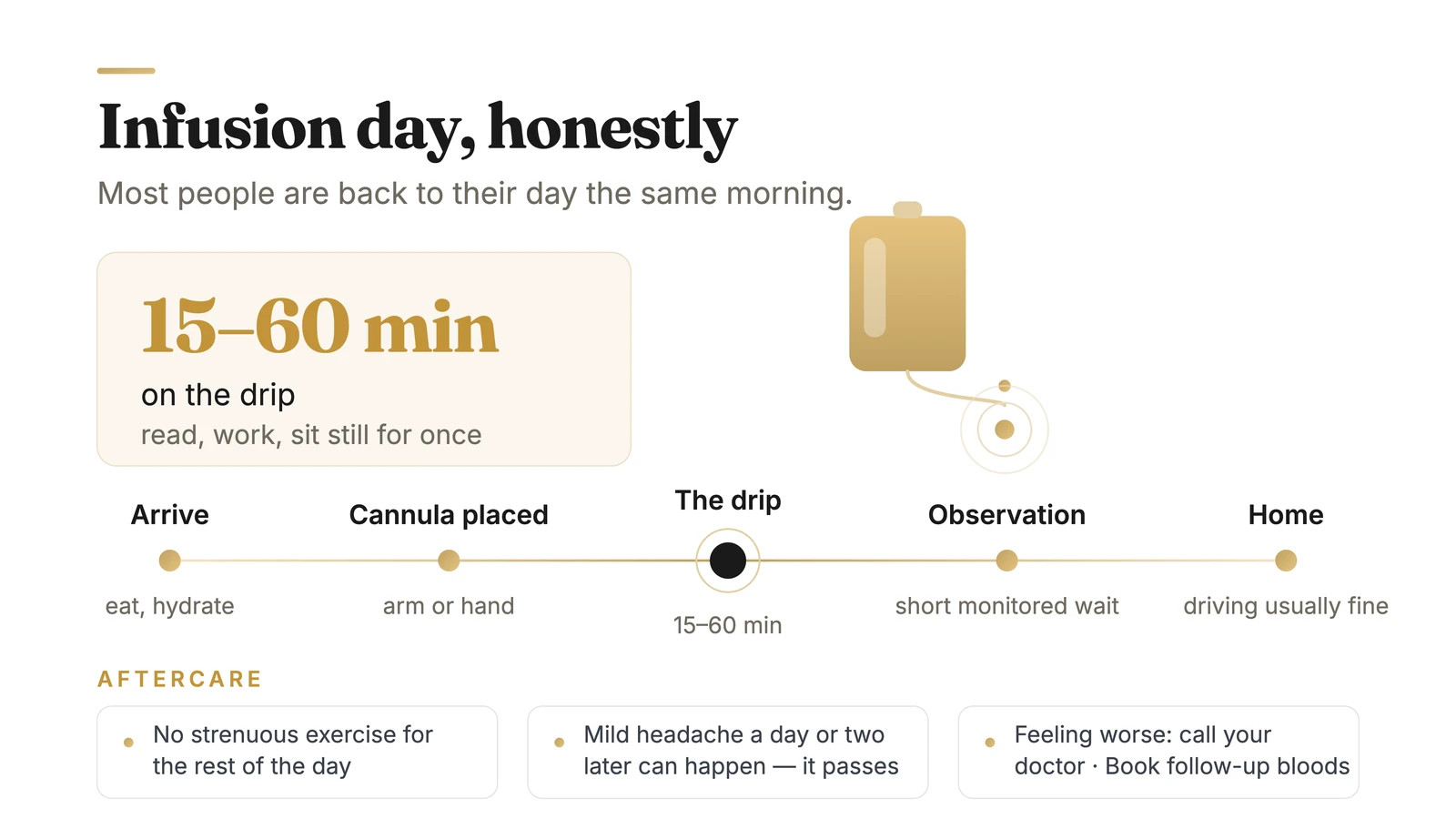
A typical iron infusion day. Timings vary with the preparation your doctor selects.
Iron infusion versus blood transfusion: not the same thing
Thousands of South Africans search "iron transfusion" every month, and it's worth clearing up kindly: an iron infusion replaces iron; a blood transfusion replaces blood. An infusion is a mineral top-up through a drip that helps your own body build healthy red cells over the following weeks. A transfusion is donor blood, reserved for serious acute situations, in hospital. If you've been tired for months, the conversation you're looking for is almost certainly the infusion one, and it starts with a blood test, not a hospital.
Cost, medical aid, and where to go in Cape Town
Straight answers, because this is the part everyone actually wants:
The consultation costs R550, 15 minutes with a doctor, in person at 183 Bree Street, Cape Town, or online. Bookings are open 24/7.
Blood tests are billed separately by the laboratory, if you don't have recent results.
The infusion itself is quoted only after the doctor has reviewed your bloods, because the preparation and plan depend on your results, and because you may not need one at all. No blind packages.
Medical aid: WellNest Gold is a cash practice, so we don't bill schemes directly. You settle your account at the time of your visit, and we give you a detailed invoice to submit to your scheme yourself. Whether they pay anything, and how much, sits between you and them.
Ready to stop guessing? Book a R550 doctor-led iron consultation and let your blood results make the decision with you.
Frequently asked questions
What causes iron deficiency?
Most commonly: heavy periods, pregnancy, low dietary iron, poor absorption such as coeliac disease or long-term reflux medication, ongoing blood loss, and endurance training. Often it's a combination, and unexplained deficiency should always be investigated by a doctor rather than just supplemented away.
What are the 3 stages of iron deficiency?
First iron stores drain, showing as low ferritin, then red-cell production struggles, and finally haemoglobin falls, which is iron-deficiency anaemia. Symptoms can start at stage one, while standard check-ups often only flag stage three.
How do I know if I have an iron deficiency?
You can't confirm it by symptoms alone, you measure it. A ferritin test plus a full blood count, read by a doctor alongside your symptoms, settles the question in one blood draw.
Is iron deficiency dangerous?
Untreated, it progresses to anaemia, which strains the heart and, at the severe end, can cause chest pain, fainting and complications in pregnancy. Caught early, it is very treatable, which is the point of testing sooner rather than later.
What is an iron infusion?
A medical treatment where iron is delivered directly into your bloodstream through a drip, bypassing the gut. It's used when tablets fail, aren't tolerated, or iron needs restoring faster, and it's administered under medical supervision.
How long does an iron infusion take?
Typically between 15 and 60 minutes depending on the preparation, plus a short observation period afterwards. Most people are back to their day the same morning or afternoon.
How long after an iron infusion will I feel better?
Iron levels rise within days, but most people feel the difference over days to a few weeks as the body rebuilds red blood cells. Follow-up bloods confirm the recovery.
What are the side effects of an iron infusion?
Commonly mild and short-lived: headache, mild nausea, or temporary muscle and joint aches a day or two later. Uncommon but important: allergic reactions, which is the reason infusions are done under medical supervision, and rarely, permanent skin staining if iron leaks outside the vein.
Can iron infusions make you tired?
Some people feel briefly flat or achy in the first day or two, then energy typically improves over the following weeks as iron stores rebuild. Persistent worsening fatigue is a reason to contact your doctor.
How many iron infusions do you need?
It depends on how depleted your stores are and the preparation used, and many people need only one or two sessions. Your doctor calculates it from your blood results.
How much does an iron infusion cost in South Africa?
At WellNest in Cape Town the doctor consultation is R550, blood tests are billed separately by the lab, and the infusion itself is quoted after your results are reviewed, because the right plan, and whether you need one at all, depends on your bloods.
Does medical aid pay for iron infusions?
WellNest Gold is a cash practice, so we don't bill medical aids directly. You settle your account at the time of your visit and we give you a detailed invoice, which you submit to your scheme yourself. Whether they pay anything, and how much, sits between you and them, and depends on your plan's rules.
Can you drive after an iron infusion?
Generally yes. Most people drive themselves home after the observation period, unless they feel unwell or their doctor advises otherwise.
What not to do after an iron infusion?
Skip strenuous exercise for the rest of the day, don't ignore symptoms that feel more than mild, and don't skip your follow-up bloods, which confirm the treatment worked.
Medical disclaimer
This article is general health information, not personal medical advice. If you're unwell, or your symptoms are severe or sudden, see a healthcare professional promptly.