





Conceptual illustration inspired by cellular biology; not a depiction of a molecule or a treatment effect.
Glutathione has an important job in the body. It helps cells manage oxidative stress and participates in the chemical reactions that protect normal cellular function. That makes it an interesting subject for medical research and a frequent topic in conversations about health and wellbeing.
Understanding its benefits starts with one distinction: what glutathione does naturally in your body is different from what taking extra glutathione has been shown to achieve. Oral supplements, intravenous treatments and topical products also need to be assessed separately.
Here is a clear look at the biology, the human studies and the questions that remain.
What is glutathione, and why does your body need it?
Glutathione is a small molecule made from three amino acids: glutamate, cysteine and glycine. It is part of the body's antioxidant system, helping to handle reactive molecules that can damage cells when their production exceeds the body's capacity to manage them.
It also participates in enzyme reactions that process certain potentially harmful compounds. These are established biochemical functions, including reactions involved in protecting red blood cells and maintaining proteins. National Cancer Institute: glutathione
This explains the scientific interest in glutathione. It does not, by itself, show that a supplement or infusion will provide an additional health benefit for everyone. A molecule can be essential to normal physiology without extra amounts reliably improving how a healthy person feels or functions.

Oral and intravenous glutathione need separate evidence assessments. Illustrative generic capsule and vial, not specific products or evidence of equivalent benefit or safety.
What have studies of oral glutathione found?
A six-month randomised, placebo-controlled trial in 54 non-smoking adults found that oral glutathione increased glutathione levels in several blood and cell measurements. Researchers also reported changes in oxidative-stress and laboratory immune-function markers. Levels returned towards baseline after supplementation stopped. Richie and colleagues, 2015
These findings support a specific conclusion: oral supplementation can influence glutathione measurements under the conditions studied. They do not establish fewer infections, longer life or a guaranteed improvement in energy.
Results have not been uniform. An earlier four-week placebo-controlled trial enrolled 40 healthy adults and found no significant improvement in the measured glutathione or oxidative-stress markers. Differences between studies, including duration and the measurements used, matter when interpreting their findings. Allen and Bradley, 2011
The useful question is therefore more precise than whether glutathione “works”: which formulation, for which person, over what period, and with what outcome?
What is the clinical evidence for IV glutathione?
Intravenous glutathione has been studied in specific medical settings. Some trials offer encouraging signals, but those findings cannot automatically be transferred to routine wellness care.
In a small randomised trial involving 40 people with peripheral arterial disease, five days of treatment were associated with improved pain-free walking distance and some circulation measurements. This was a short study in people with a diagnosed vascular condition, rather than a trial of fitness or recovery in healthy adults. Arosio and colleagues, 2002
A separate trial of 100 people undergoing emergency angioplasty for a particular type of heart attack reported favourable changes in inflammatory and oxidative-stress measures, and in the heart's size and pumping function on imaging. The trial was sized to detect a biomarker change, not differences in deaths or further heart attacks. The treatment was delivered alongside specialist cardiac care. It did not test whether elective glutathione infusions prevent heart attacks or improve everyday wellbeing. Tanzilli and colleagues, 2021
Other results have been less clear. A placebo-controlled pilot study of 21 people with Parkinson's disease found no statistically significant difference in changes to its main symptom-rating scores. The authors called for a larger study. Hauser and colleagues, 2009
Together, these studies justify further research. They do not establish a general benefit from IV glutathione for fatigue, exercise recovery, healthy ageing or disease prevention in otherwise healthy people.
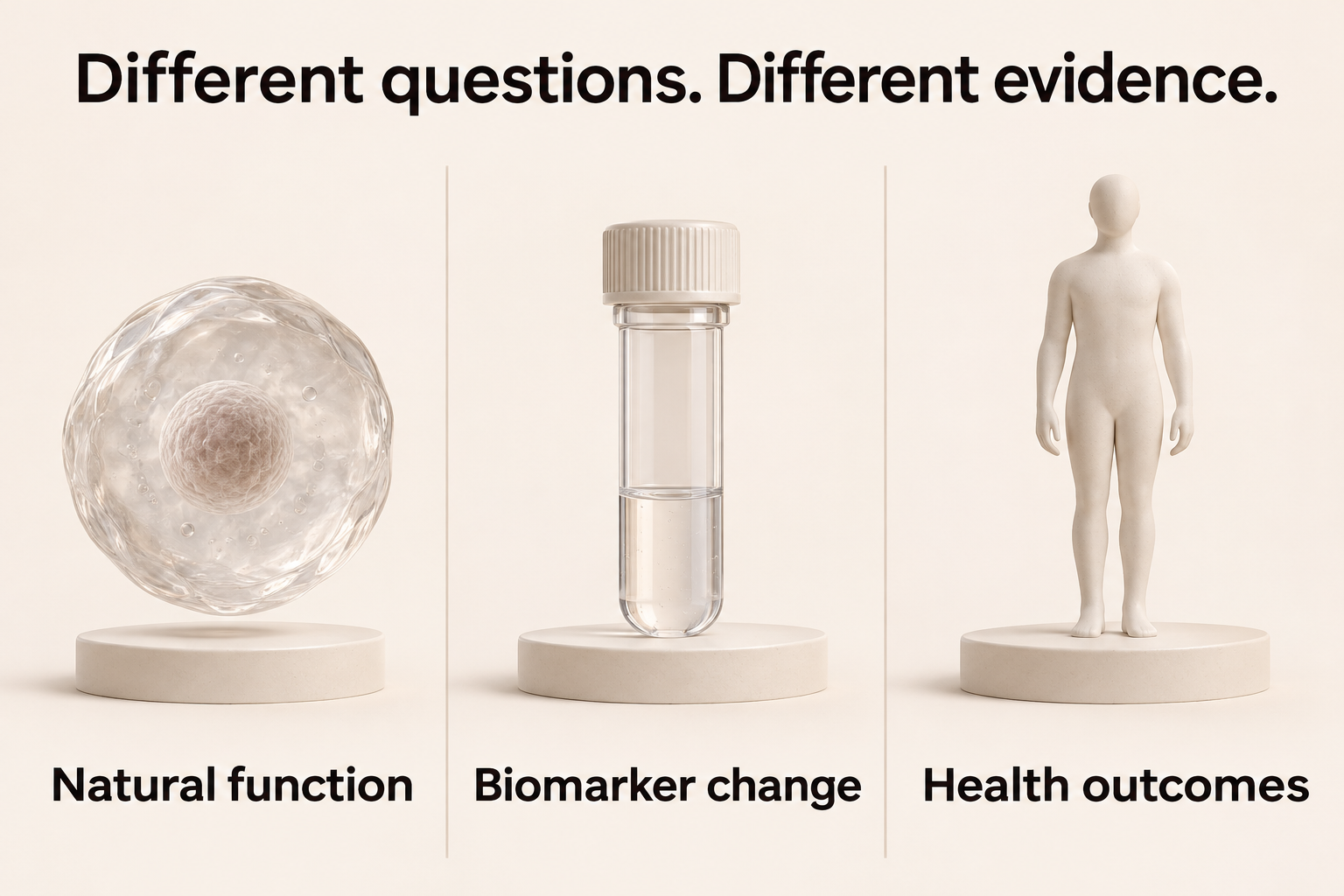
A change in a blood measurement is different from a demonstrated health benefit. Sources are linked in the article.
Why do the route and the outcome measured matter?
Evidence for a capsule cannot establish the benefits or safety of an infusion, and neither tells us about a topical product. Likewise, a study of a combination product cannot tell us that every observed effect came from glutathione alone.
It also helps to distinguish a biomarker from an outcome you can feel. A higher glutathione concentration or a change in a laboratory immune marker may be scientifically useful. It is not equivalent to recovering faster, getting sick less often or living longer. Those benefits require studies that measure those outcomes directly.
This distinction is especially useful when reading claims about “detox”, immunity or anti-ageing. Glutathione's natural role is real; a broad promise about an optional treatment needs its own evidence.
What about skin claims?
Skin-lightening research should not be presented as evidence of better overall health, and lighter skin is not healthier or more desirable.
One small, placebo-controlled study enrolled 50 women, and 32 were included in the final results. The injection contained glutathione, ascorbic acid, hydrolysed collagen and sodium chloride, and the treated group also received vitamin C, so effects cannot be attributed conclusively to glutathione alone.
Eight treated participants developed abnormal liver tests and one had anaphylactic shock. Those nine, and their controls, were excluded from the efficacy analysis, so the final comparison leaves out the people with the most serious reactions. Among the 32 who remained, 6 of 16 improved with treatment and 3 of 16 with placebo (p = 0.054). Adverse effects were noted in all subjects, and at six months after treatment only one patient had kept the improvement. The study does not provide a sound basis for promising safe, lasting cosmetic results. Zubair and colleagues, 2016
Safety and product quality are part of the evidence
“Naturally occurring” does not mean that every formulation or route is risk-free. Product quality is particularly important when something is administered directly into a vein.
In August 2026, the US FDA reported adverse events in at least 30 people after IV glutathione, alone or in mixtures. The reports involved compounded products made using a particular lot of a dietary-supplement-grade ingredient, with concerns about bacterial endotoxins. The agency reminded compounders that dietary-supplement-grade ingredients are unsuitable for making injectable medicines. FDA compounding notice, 27 August 2026
That alert concerns the products and supply chain described by the FDA; it is not evidence about a particular South African clinic. It illustrates why ingredient suitability, sterile preparation, traceability and clinical oversight matter. A small study reporting good short-term tolerance cannot establish the long-term safety of repeated elective infusions.
Questions that make a health conversation more useful
If glutathione comes up in a consultation, a helpful discussion should cover:
What specific problem or outcome are we trying to address?
Does the evidence match the proposed route and my circumstances?
What alternatives are available, including whether treatment is needed at all?
What are the relevant risks, uncertainties and monitoring requirements?
How would we judge whether there has been a meaningful benefit?
Glutathione is an important part of human biology and a worthwhile area of research. Making a good decision about supplementation or treatment means keeping that science connected to the actual evidence, your health context and a clear purpose.
This article provides general education. It is not a diagnosis, prescription or individual treatment recommendation.