



For decades, regenerative medicine has been built around a compelling question:
Which cells can replace what the body has lost?
Secretome science asks a more disruptive one:
What if much of the healing power of a cell comes not from what it becomes, but from what it communicates?
Cells do not work in silence. They release a complex collection of biological signals: growth factors, cytokines, chemokines, lipids, proteins, nucleic acids and membrane-bound extracellular vesicles. Collectively, this is the secretome.
Extracellular vesicles are the membrane-bound particles within that wider mix. Exosomes are one subtype of extracellular vesicle, formed through a specific pathway inside the cell. The three terms are often used as if they were interchangeable, but they are not. International scientific guidance now encourages researchers to use precise extracellular-vesicle terminology unless a product’s origin and formation pathway have actually been demonstrated.
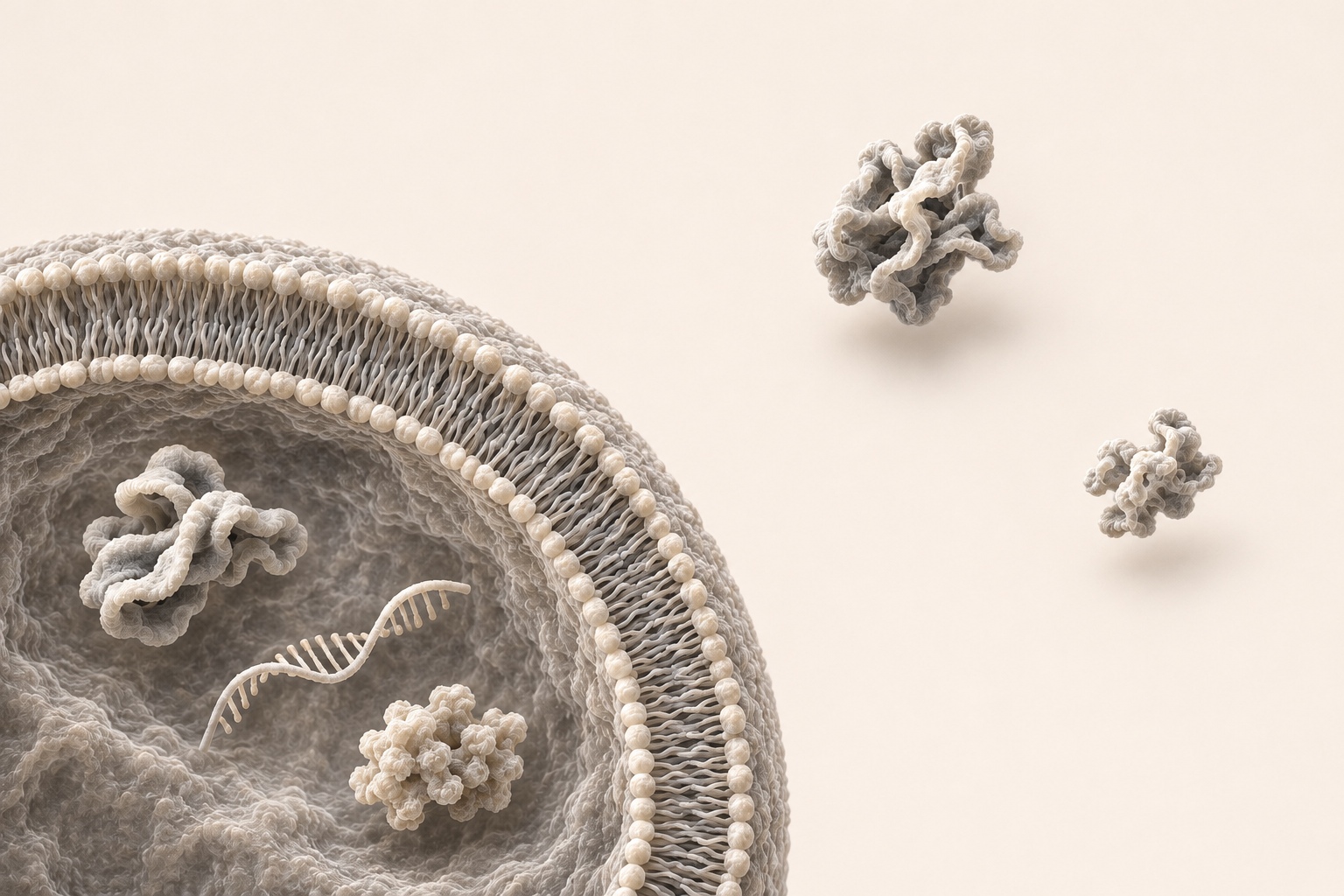
The secretome can include extracellular vesicles and soluble factors. Conceptual illustration, not to scale. Not every extracellular vesicle is an exosome.
That distinction may sound technical.
It is not.
It separates a defined biological product from an attractive label.
From replacing tissue to delivering instructions
The central idea is elegant: rather than administering living cells and hoping they survive, migrate and behave as intended, we may be able to isolate the signals through which cells influence inflammation, immune activity, tissue repair and remodelling.
In principle, this could create biological treatments that are easier to store, standardise and deliver than living-cell products. It could eventually enable scientists to engineer specific molecular messages towards specific tissues.
Much of that reasoning comes from laboratory and animal research. The studies below are human studies, and most are small and early.
But potential is not proof, and the most important recent studies are valuable precisely because they show us both.
In a 2025 study published in Signal Transduction and Targeted Therapy, 24 people with pulmonary fibrosis were randomised to receive nebulised umbilical-cord mesenchymal-stromal-cell extracellular vesicles or saline alongside routine care. The treatment was tolerated without serious treatment-related adverse events, including during 12 months of follow-up.
Measures including forced vital capacity, maximal voluntary ventilation and respiratory symptom scores improved. However, meaningful radiological regression was limited to two patients. The signal was encouraging, but the trial was small and designed primarily around safety.
That is how responsible translation begins: not with a miracle claim, but with a measurable signal and an honest account of its limits.
The same message, different tissues?
The attraction of secretome therapy is its apparent breadth. Researchers are investigating extracellular-vesicle and secretome products across respiratory disease, musculoskeletal injury, dermatology, cardiovascular disease, neurological disorders and inflammatory conditions.
Yet breadth becomes a weakness when one biological category is marketed as a universal solution.
Consider osteoarthritis.
A 2025 dose-ranging human study reported symptom improvements following umbilical-cord MSC-derived extracellular-vesicle injections. But there was no placebo group, no significant difference between the three doses, and MRI follow-up was limited to a subset of participants.
Now compare that with a 2024 randomised, triple-blind, placebo-controlled trial that enrolled 31 people (62 knees), of whom 29 people (58 knees) were analysed. A single placental-MSC extracellular-vesicle injection was well tolerated, but no statistically significant benefit over saline was shown for pain or function at two or six months, or for MRI findings at six months.
That contrast is not an inconvenience to hide. It is the reason controlled trials exist.
Improvement after treatment is not always improvement because of treatment.
Dermatology is taking similarly measured steps. A 2025 study published in Cytotherapy tested a topical MSC-exosome ointment over 20 days. It was well tolerated, but the small, open-label study involved ten healthy volunteers and focused on safety, so it does not establish efficacy in patients with psoriasis.
The lesson is not that secretomes work or that they do not.
The lesson is that “secretome therapy” is not one therapy.
The source cell, donor profile, culture conditions, oxygen exposure, purification method, dose, route of administration, storage process and disease environment can all change the biological message being delivered.
When a positive signal is not yet an answer
This is where the field must resist its own excitement.
In a multicentre, double-blind phase II trial published in CHEST, 102 patients with COVID-related acute respiratory distress syndrome received a bone-marrow-MSC extracellular-vesicle product or placebo.
Mortality was numerically lower in the higher-dose group, but the primary outcome did not establish a statistically definitive benefit across the full intention-to-treat population. A younger subgroup produced a stronger signal, but subgroup findings are a reason to run the next trial, not a licence to declare victory.
In cardiovascular medicine, Professor Philippe Menasché and colleagues reported the first use of a cardiovascular-cell-derived secretome in a patient with severe heart failure in EBioMedicine in 2024. It was an important translational milestone, but still a single-patient case report: evidence of feasibility, not efficacy.
Neurology presents the same boundary. A 2024 early investigation of bone-marrow MSC-derived extracellular vesicles in people with amyotrophic lateral sclerosis reported encouraging tolerability, while explicitly concluding that controlled studies were still required.
We have now returned to the original question.
The challenge is no longer simply whether cells can “speak.” It is whether we can identify the speaker, decode the message, control the dose and prove that it reaches the right biological destination.
The real breakthrough will be standardisation
The future of this field may be decided less by biological spectacle than by manufacturing discipline.
Two secretome preparations produced from the same nominal cell type may not be equivalent. A credible therapeutic therefore needs a reproducible identity, purity profile, potency assay, sterility controls, validated storage conditions and evidence that each batch performs its intended biological function.
The International Society for Extracellular Vesicles developed its MISEV2023 framework because inconsistent isolation, characterisation and reporting make studies difficult to reproduce or compare.
Regulation is equally important, and this is the US position rather than South African law. The FDA’s public safety notification on exosome products, dated December 2019, reported serious adverse events in patients treated with unapproved products marketed as containing exosomes, and stated that there were no FDA-approved exosome products. That notice does not report deaths linked to exosomes.
“Natural” does not mean standardised, sterile, potent or safe.
That is not a reason to retreat.
It is a reason to raise the standard.
At WellNest, our aim is a physician-led approach built around longitudinal health data, advanced diagnostics and responsible technology, not a retail shortcut around evidence.
For emerging therapies, the questions must be relentless:
Which patients? Which product? Which dose? Which endpoint? For how long? Compared with what? And what happened to every patient, not only the success stories?
The organisations that lead this category will not be those making the loudest promises. They will be those publishing the clearest protocols, measuring outcomes transparently and being willing to discover that a therapy works only in a narrow group or does not work at all.
Secretome therapy may represent a profound shift: from transplanting biological machinery to delivering biological instructions.
But a message becomes medicine only when it is understood, reproducible and proven.
Editorial note: Secretome and extracellular-vesicle therapies remain investigational for many indications. This article is educational thought leadership and does not constitute medical advice or a treatment recommendation.