




This article provides general information. Symptoms can have many causes and should not be used to diagnose iron deficiency.
You slept for nine hours, but the morning still feels heavy. The stairs seem steeper than they used to. Your concentration fades halfway through the afternoon, and there seems to be more hair in the shower.
It is reasonable to wonder whether your iron is low.
Low iron can contribute to symptoms like these, but so can poor sleep, stress, thyroid problems, infection, medication effects and several other conditions. The useful next step is not to guess. It is to understand the symptoms, test properly and work out what is driving the problem.
At a glance
Iron deficiency means your body does not have enough available iron to meet its needs.
Iron-deficiency anaemia develops when the shortage affects haemoglobin and red-blood-cell production.
You can have depleted iron stores before becoming anaemic.
Symptoms provide clues, but bloodwork is needed to investigate them properly. Fatigue alone is not a diagnosis.
Tablets are usually the first treatment route. IV iron is considered in selected circumstances.
An iron infusion is a medical treatment, not a generic energy drip.
What are the signs of low iron?
Low iron may be associated with:
persistent tiredness or weakness;
reduced exercise capacity;
breathlessness during ordinary activity;
dizziness or headaches;
difficulty concentrating or “brain fog”;
restless legs;
noticeable hair shedding; and
nail changes in more established cases.
Not everyone experiences the same symptoms. Some people with early iron depletion have few obvious signs, while someone with significant symptoms may have an entirely different cause.
That is why the right question is not simply, “Do my symptoms match?” It is, “What do my symptoms and blood results show together?” WHO’s anaemia overview and the British Society of Gastroenterology guideline both support testing and investigation rather than symptom-based diagnosis.
The World Health Organization estimates that 30.7% of women aged 15–49 worldwide had anaemia in 2023, about three in ten. This figure covers anaemia from all causes. It is not the percentage of women with iron deficiency, and it certainly is not the percentage who require an iron infusion. WHO global anaemia estimates
Iron deficiency is an important cause, but anaemia can also arise from inflammation, chronic disease, infection, inherited blood conditions and other nutrient deficiencies.
Can you have low iron without anaemia?
Yes. Iron stores can become depleted while haemoglobin remains within the laboratory reference range. This is often called iron deficiency without anaemia.
If the shortage continues, some people later develop iron-deficiency anaemia. But there is no identical progression for everyone, and there is no useful online “three-stage” checklist that replaces individual interpretation.
What matters is the full picture: your symptoms, blood results, possible blood loss, pregnancy status, other health conditions and how quickly things have changed.
Get urgent medical help instead of making an elective infusion booking if you have chest pain, fainting, severe or sudden breathlessness, breathlessness at rest, significant active bleeding, black or bloody stools, rapid deterioration or severe symptoms during pregnancy.
What causes iron levels to fall?
Low iron usually develops because iron is being lost, poorly absorbed, insufficiently replaced or required in greater amounts.
Common reasons include:
heavy or prolonged periods;
gastrointestinal blood loss;
pregnancy, childbirth and postpartum recovery;
frequent blood donation;
a diet providing insufficient absorbable iron;
coeliac disease or other absorption problems;
inflammatory bowel conditions;
bariatric or other gastrointestinal surgery; and
inflammation or chronic disease that affects how the body handles iron.
Vegetarians, vegans, endurance exercisers and frequent donors may be more alert to the possibility of low iron, but membership of a group does not establish the cause.
Finding the cause matters. Replacing iron without understanding why it became low may leave ongoing blood loss, poor absorption or another condition unaddressed.
Which blood tests help identify iron deficiency?
A full blood count and ferritin are common starting points. Depending on the circumstances, iron studies, transferrin saturation and an inflammation marker such as CRP may also help.
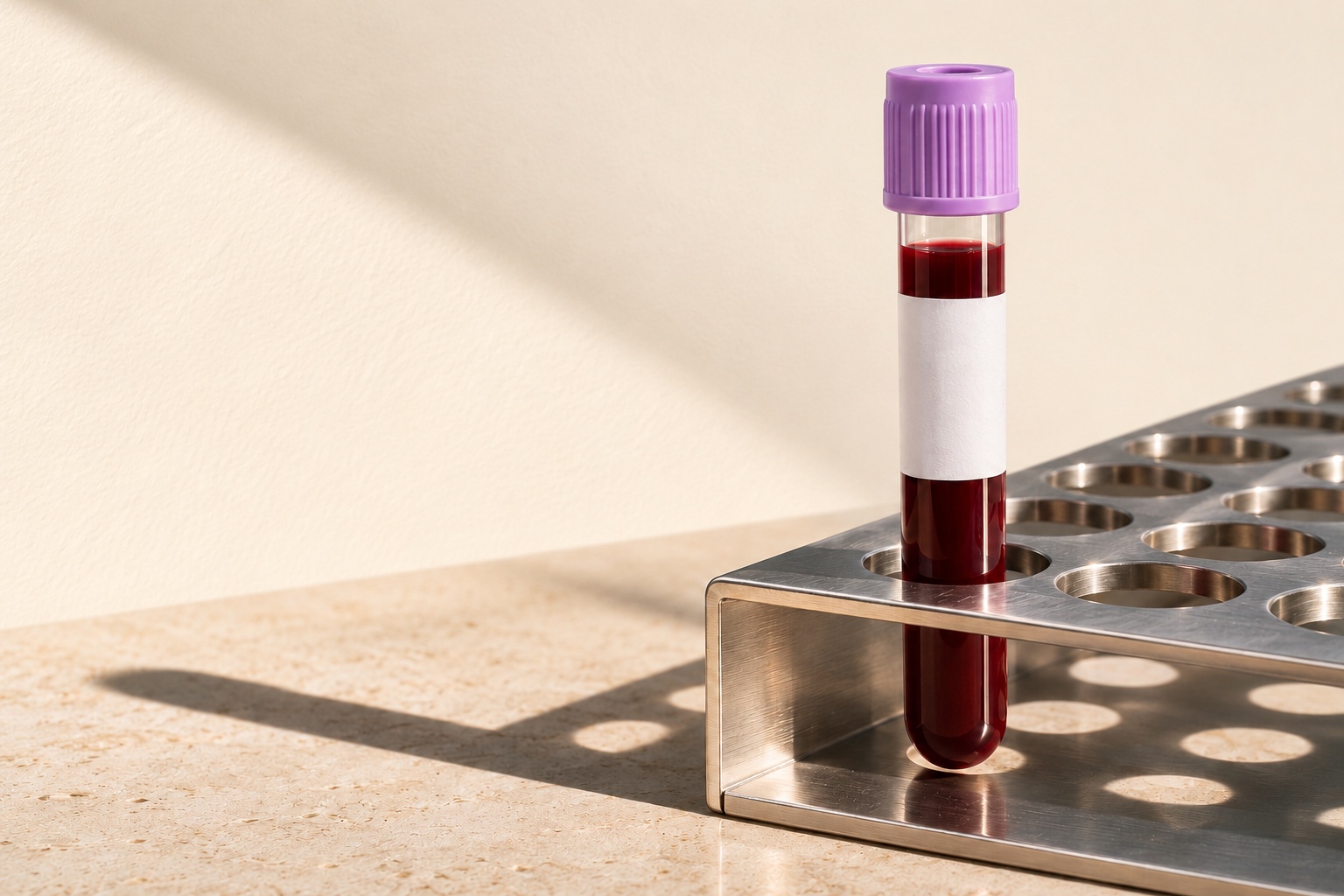
Blood tests help assess iron status and possible causes. Illustrative image; the tube does not specify the specimen required for every test.
Ferritin reflects stored iron, so a low result can indicate depleted stores. The complication is that ferritin can rise during inflammation, infection or liver disease. A result that appears normal may therefore not tell the whole story.
This is why one ferritin value should not be read as a self-contained diagnosis or an automatic instruction to have an infusion. Results make more sense when interpreted with symptoms, haemoglobin, inflammation, medical history and the likely cause. WHO ferritin guidance
Does one iron or ferritin level mean you need an infusion?
No. There is no single ferritin, serum-iron or haemoglobin number that automatically means IV iron is the right treatment.
The decision depends on several questions:
Is iron deficiency actually present?
Is anaemia present, and how significant is it?
What caused the deficiency?
Is blood loss continuing?
Have tablets been tolerated and used appropriately?
Has oral treatment produced the expected response?
Is absorption likely to be poor?
Is faster replenishment clinically important?
Are there individual risks that influence the choice?
The test result starts the treatment discussion; it does not finish it.
Tablets or IV iron: which route makes sense?
For most people, oral iron is the usual first treatment route. It is accessible and avoids an IV procedure, but it works gradually and can cause nausea, stomach discomfort, constipation or diarrhoea.
IV iron may be considered when oral treatment is not tolerated, has not worked as expected, is unlikely to be absorbed, or when more rapid replenishment is clinically important. AGA Clinical Practice Update
Oral iron | IV iron | |
|---|---|---|
How it is taken | By mouth | Through a vein in a clinical setting |
Usual role | First route for most people | Selected when oral treatment is unsuitable or insufficient |
Replenishment | Gradual | Faster replenishment of iron stores, although symptom and haemoglobin changes still take time |
Common drawback | Gastrointestinal effects and the need for consistency | Requires an appointment, cannula and monitoring |
Number of treatments | Usually a course over time | One or more treatments, depending on the product and calculated need |
Main risks | Poor tolerance, interactions or inadequate absorption | Infusion reactions, rare serious allergic reactions, IV-site injury or lasting skin staining, and low blood phosphate with ferric carboxymaltose |
There is no universal winner. The aim is to select the most appropriate route for the person and the reason their iron became low.
What happens during an iron infusion?
If IV iron is considered appropriate, the formulation and dose are selected from the blood results, calculated iron requirement, health history and previous treatment.
At the appointment, a nurse places a cannula into a vein and administers the prescribed iron under WellNest medical supervision. The patient and IV site are monitored. Administration time differs by product and dose, and the total appointment also includes preparation and observation.
One or more infusions may be needed. Iron stores can be replenished faster than with tablets, but people do not receive an instant surge of energy. Blood results and symptoms change over time, and persistent symptoms may have another explanation.
Product names local and international patients may recognise
People who received treatment elsewhere may have a different brand name in their records:
Active ingredient | South African name | International name patients may recognise |
|---|---|---|
Iron sucrose | Venofer® | Venofer® in many markets |
Ferric carboxymaltose | Ferinject® | Injectafer® in the United States |
Ferric derisomaltose | Monofer® | Monoferric® in the United States and Canada |
These names help identify previous treatment. They are not interchangeable product choices and do not guarantee availability or prescription. If you were treated outside South Africa, bring the product name, dose, date, country, recent blood results and details of any reaction.
Possible side effects
Short-term effects may include headache, nausea, dizziness, flushing, altered taste, muscle or joint aches, a feverish feeling, blood-pressure changes or discomfort around the IV site.
Some people temporarily feel tired or achy after treatment. New, severe, persistent or worsening symptoms should not simply be dismissed as “the infusion working”.
Iron leaking outside the vein can cause pain, swelling and potentially lasting brown skin staining, so burning or discomfort around the cannula should be reported immediately. Serious allergic reactions are uncommon but possible, which is why IV iron is administered with monitoring in an appropriately equipped setting. EMA IV-iron safety recommendations
Different formulations also have different product-specific risks, which should be explained when a specific treatment is prescribed. Not every iron infusion is the same.
Low blood phosphate with ferric carboxymaltose. Ferric carboxymaltose is known to commonly lower blood phosphate. This is often temporary and may cause no symptoms, but tell your clinician about new or worsening tiredness, muscle weakness or bone pain after treatment. Rare reports describe softened bones (osteomalacia) and fractures, mainly in people with existing risk factors or after prolonged exposure to high doses. Your clinician decides whether phosphate needs to be checked. MHRA Drug Safety Update
Is an iron infusion the same as a blood transfusion?
No. An iron infusion delivers an iron-containing medicine through a vein. A blood transfusion provides donor red blood cells and is used in different, often more urgent circumstances.
“Iron injection” is less precise and may refer to medicine administered into a vein or muscle. If the term appears in an old record, confirm the product and route rather than assuming what was given.
What does a WellNest iron consultation cost?
The doctor-led focused consultation is R550 online or R1,200 in clinic, and both are currently listed as 15 minutes.
Blood tests are required before the consultation and are billed separately by the laboratory. The current estimate is R1,000–R1,500 including VAT, but this is an estimate rather than a quote.
If an infusion is prescribed, it is priced and billed separately once the product and dose are known.
Booking a consultation does not guarantee an infusion.
Consultations are available only within South Africa: by telehealth while the patient is in South Africa or in person at 183 Bree Street, Cape Town. WellNest does not provide cross-border consultations. Any prescribed infusion takes place in person in an appropriate clinical setting.
Medical-aid reimbursement varies by scheme, plan, indication, authorisation and claims process. It should not be assumed in advance.
Start with answers, not assumptions
If you are constantly tired, struggling with normal exercise or trying to understand a low ferritin result, you deserve a clearer answer than “take more iron” or “book a drip”.
The sensible sequence is straightforward: understand the symptoms, test what matters, identify the likely cause and then choose the most appropriate treatment route.
Book an Iron Infusion Consultation to review your history and relevant bloodwork. The consultation fee (R550 online, R1,200 in clinic) excludes laboratory testing and any separately prescribed infusion, and an infusion is never automatic.